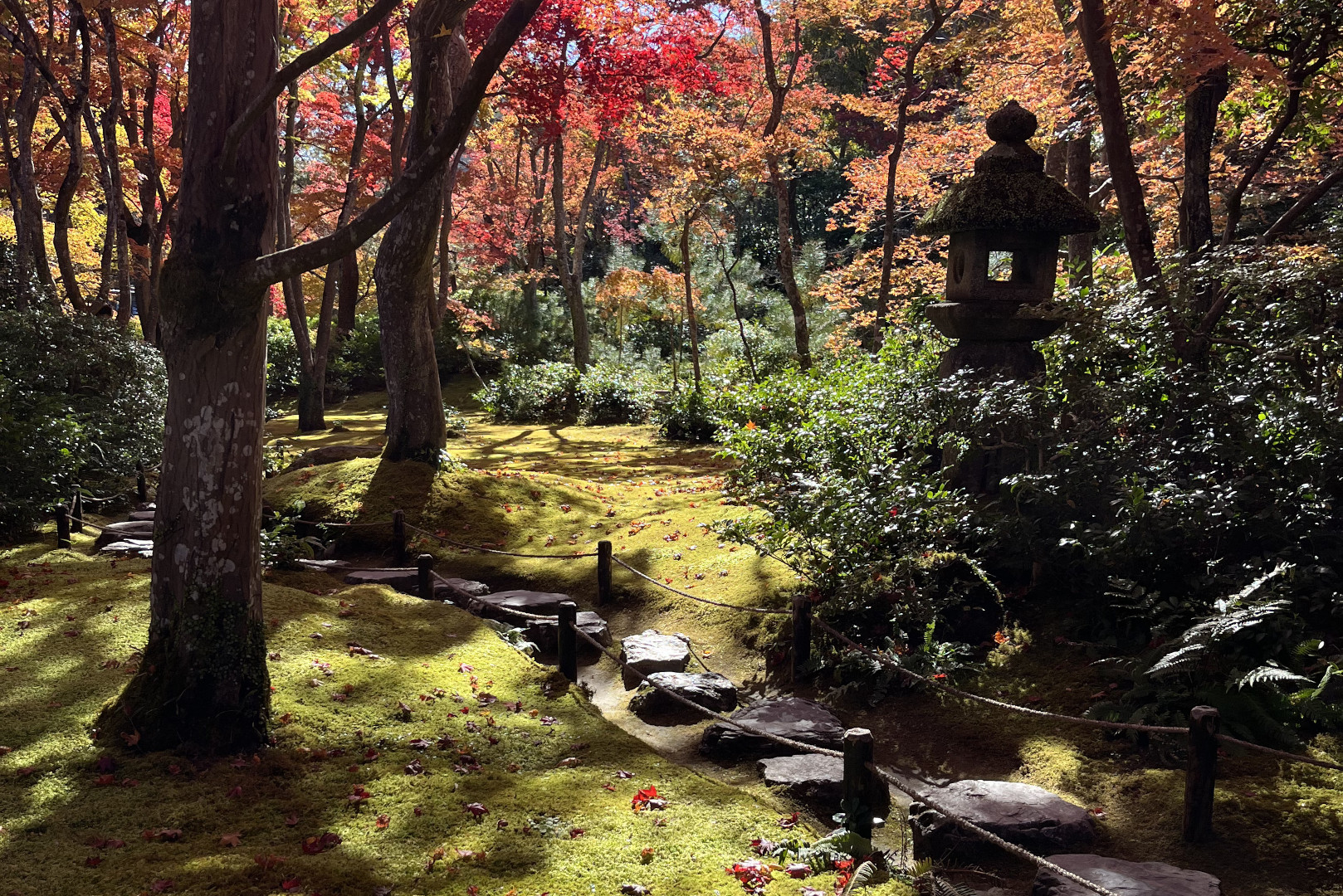
Spending a momijigari week in Kyōto. Nothing more and nothing less.
Having rented an apartment south of the commercial center for a full week, we hoped it would be enough time to get to know what is arguably the most renowned historical city in Japan. How naive. The frenzy of momijigari (紅葉狩り)—the pursuit of the most beautiful and evocative autumn foliage (kōyō, 紅葉)—was in full swing. The term derives from the Japanese maple (momiji), whose branches can display the entire spectrum of autumn colors, from green through yellow to deep red, often on a single tree.
During the peak weekend, the city was truly crowded, mostly with Japanese tourists on short visits. It is no surprise that we did not manage to complete our planned itinerary in full (see the end of this post); nevertheless, what we experienced was unforgettable. In keeping with the spirit of momijigari, we focused primarily on the city’s fringes, where atmospheric temples and residences—with their gardens—abound at the foot of the forested hills.
The most important places on our route in the sequence of our visit…
Higashi Hongan-ji 東本願寺 After arriving at Kyōto’s main railway station, we decided to walk by foot to our accommodation, and inevitably passed by the huge Higashi Hongan-ji, unfortunately it was already closing time. Belongs to the “eastern” branch of Jōdo Shinshū (“Pure Land”) sect of Japanese Buddhism. See wikipedia article. The competition in the form of “western” branch of Pure Land resides… just west of this temple, in Nishi Hongan-ji 西本願寺. See another wikipedia article as well. The both sects were somehow artificially (east/west?) divided by shōgun Tokugawa Ieyasu, and the popular belief is that his intention was to make the both branches quarrel forever so that Pure Land does not become too powerful again. We never came back to these town temples, concentrating on the ones at the foot of the hills surrounding Kyōto.
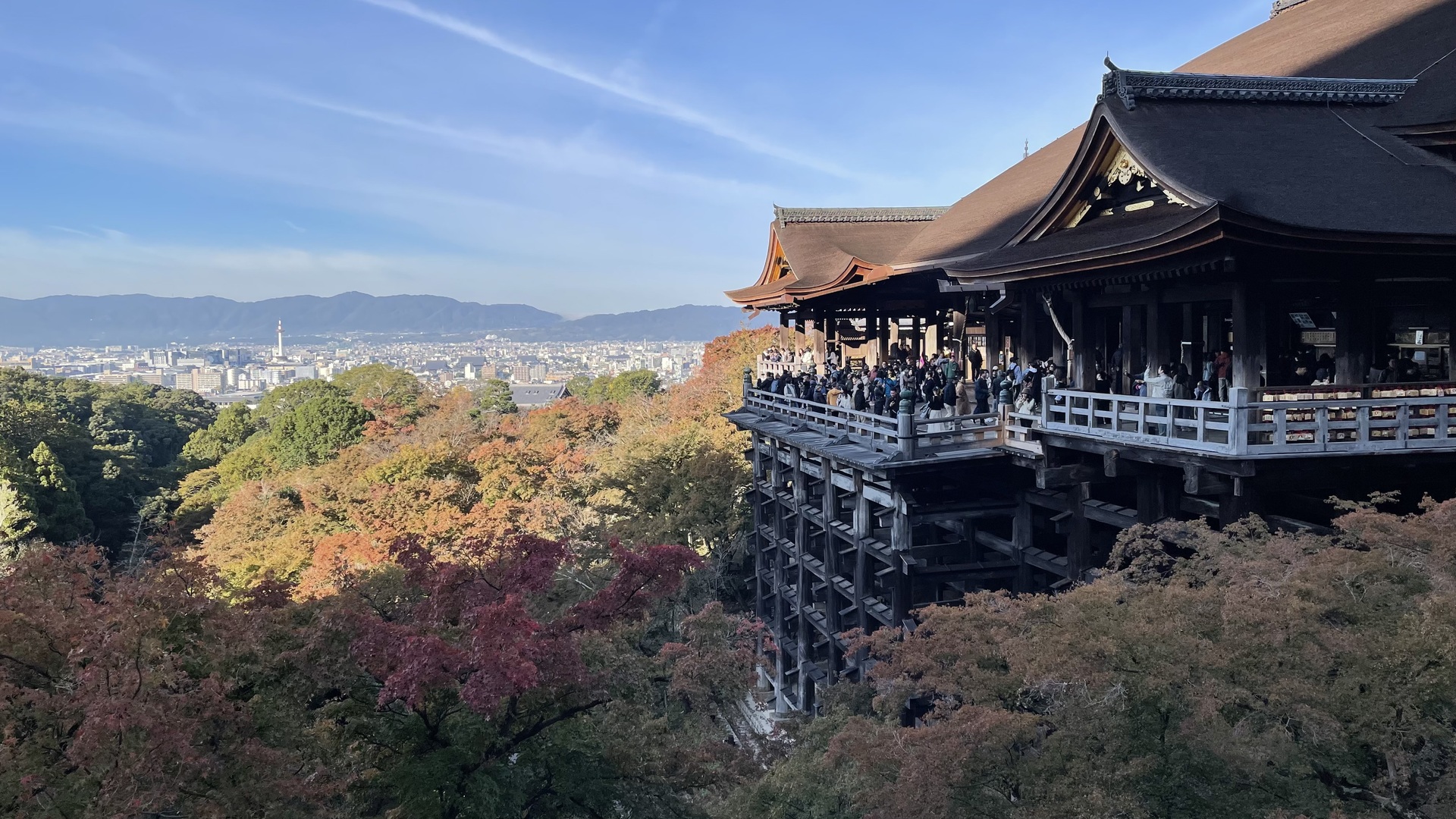
Kyōto :: Kiyomizu-dera
Kiyomizu-dera 清水寺 in the early morning, however already getting crowded with school excursions. Owned by a specific yogic school of Japanese Buddhism, Kita-Hossō, it is one of the most iconic historic places in Kyōto, with a most-photographed city panorama from the main temple hall (hondō) high terrace. It was believed in the past, that if you survive the jump from this terrace (pictured, over 12m fall) all your wishes will be fulfilled. Death rate was some 15%. The surrounding gardens are worth visit, but it is probably better to save time for other Higashiyama quarter attractions. Definitely overcrowded. Wikipedia article.
Shinnen-zaka & Ninnen-zaka neighbourhoods, which are probably the most touristy streets of southern Higashiyama-ku. Seemingly, there are still some well hidden businesses offering traditional or modern Japanese stuff, but, believe me, all of that has been already discovered and described in social media with all details.
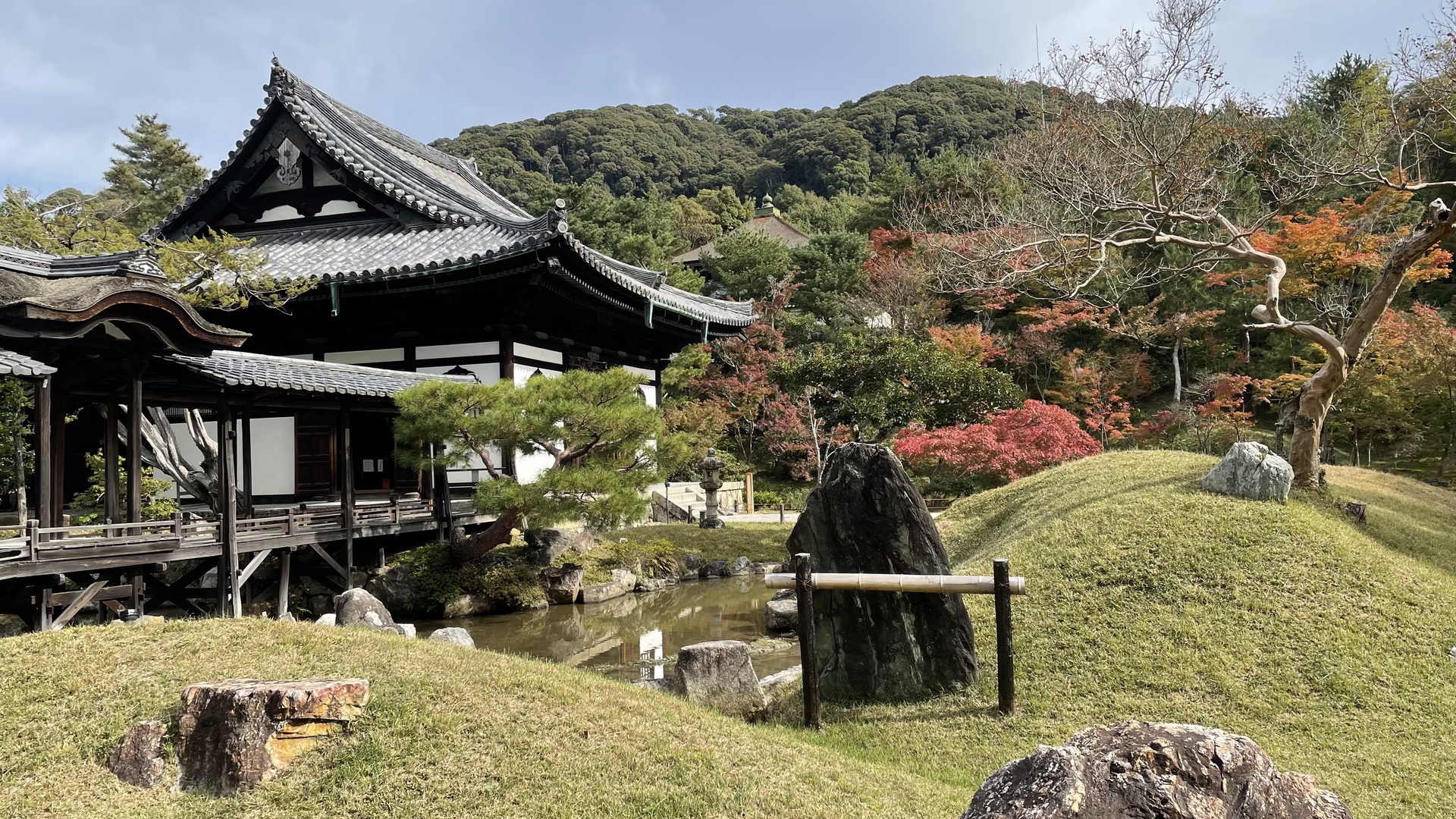
Kyōto :: Kōdai-ji
Kōdai-ji 高台寺, an extremely elegant temple in an already much quieter part of Higashiyama-ku, founded by the renowned female figure of the Toyotomi clan, Kita no Mandokoro, also known as Lady Nene (Nene-san)—officially in memory of her husband, the famous Toyotomi Hideyoshi, but simultaneously as her own place to retire as a Buddhist nun. No surprise that her adopted Buddhist nun name was Kōdai-in 高台院, which is the same as that of the temple. She used to reside in buildings of what is now a sub-temple named Entoku-in 圓徳院 with an elegant garden (a separate entrance opposite to Kōdai-ji!). Eventually, after her death she was enshrined together with her husband in an elegant mausoleum pavilion Otamaya which can be reached by a bridge over a pond. Aristocratic sponsorship with a refined taste can be felt until today. There is also a beautiful bamboo grove just above the temple, recommended for all who cannot stand the crowds in Arashiyama. In 2023 parts of the temple were in renovation.
Maruyama-Kōen 円山公園, a park on a hill ridge just East of the main street T-junction in Gion district is renowned for its Japanese cherry trees (sakura 桜) and therefore a perfect place for hanami 花見 in spring — with trees illuminated by night. But we were there in autumn — just on the way on the way from Kōdai-ji to Chion-in along the Nene-no-michi street. The main attractions are the well-known large Gion Weeping Cherry Tree (shidarezakura) 祇園しだれ桜, famous restaurants and Yasaka-jinja, of course.
Yasaka-jinja 八坂神社 on the top of the hill towering over Gion serves as the main shintō shrine for this district and therefore known also as Gion-jinja 祇園神社. It is dedicated to the god Susanoo, the brother of the goddess Amaterasu and his numerous family and is the epicenter of the Gion Matsuri 祇園祭 festival taking place in July each year, with wooden floats and portable shrines carried all around the town. There are also New Yeat festivities and a lantern festival in March. Gion loves parties.
Chion-in 知恩院, being the headquarters of the main(?) branch Jōdo Shinshū (“Pure Land”) sect of Japanese Buddhism and therefore a bit too important and official for many. It has a massive, truly colossal entrance gate that leaves no doubt about its assumed role—a feeling confirmed by the presence of the largest bell in Japan and the omnipresent Tokugawa shōgun family kamon everywhere on the palace-like buildings—a temple clearly built to impress. During our visit there was an official ceremony of a group of lay believers all in a special attire with the presence of the abbot driven around in a shiny black limousine. Wikipedia.
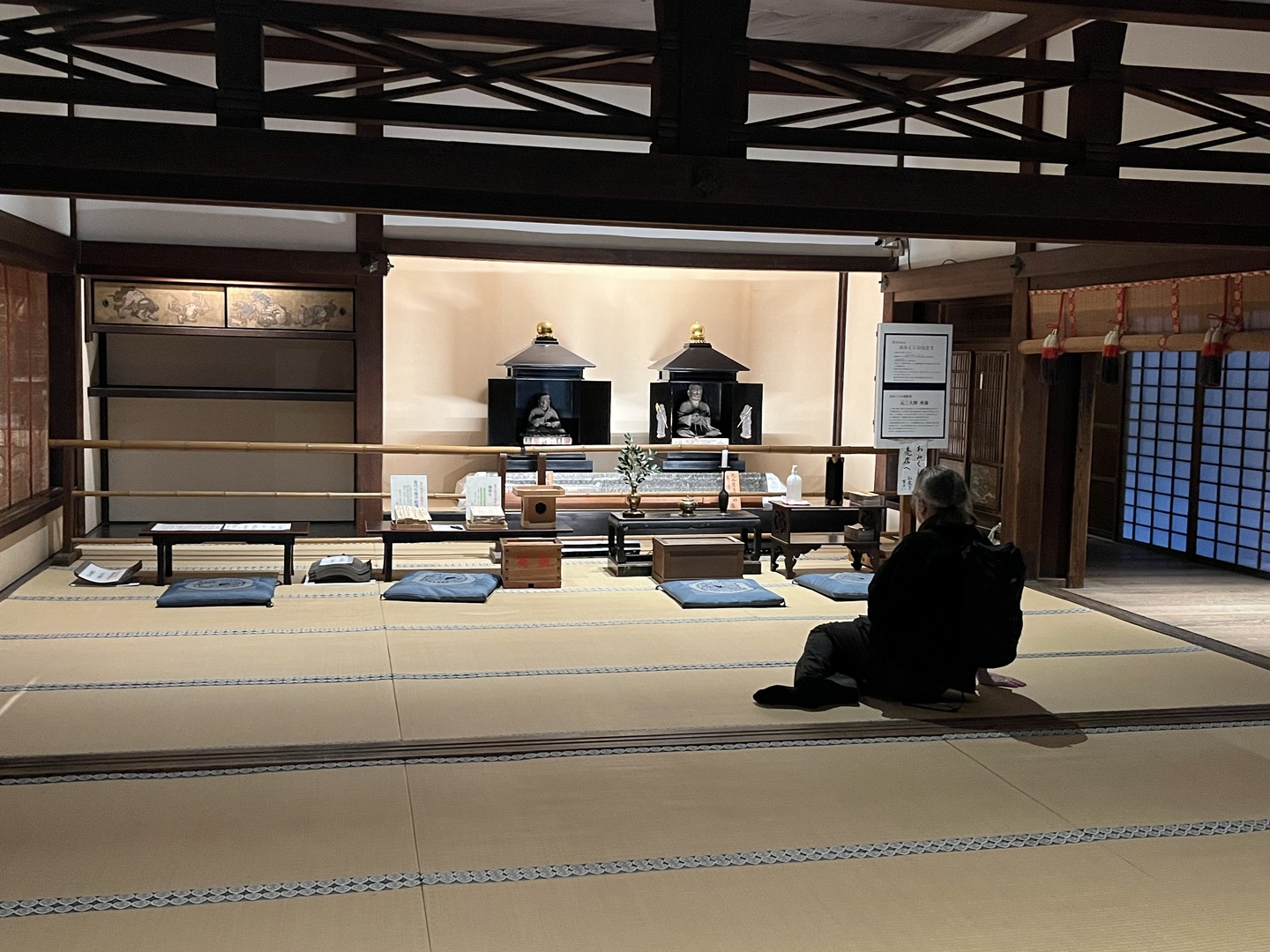
Kyōto :: Shōren-in
Shōren-in 青蓮院, just an hour before closing, our preferred temple in this part of the town. It belongs to the old-tradition Tendai school of Japanese Buddhism, originating from the 9th century, with historical headquarters in the temple Enryaku-ji at Mount Hiei. The previous and present head priests of the temple belong to the imperial family, as was also the case in the past; they are obliged to perform rites and pray for the prosperity of the Imperial House and the nation of Japan. The temple grounds and interiors are simply exquisite. Noticeably, there are four very old, shady kusunoki (camphor) trees, probably remembering the founding time of the temple. Wikipedia.
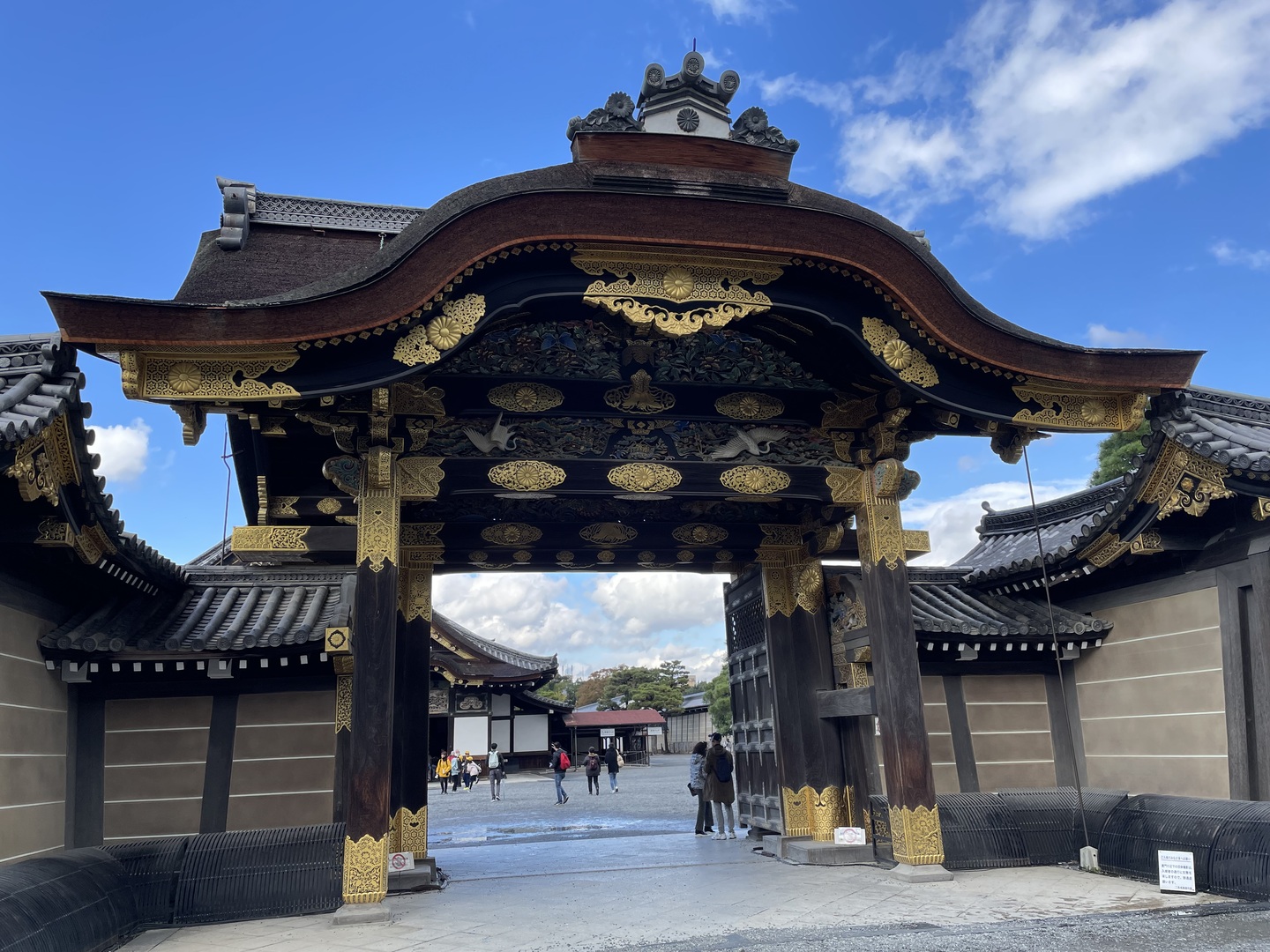
Kyōto :: Nijō-jō
Nijō-jō Castle 二条城, the residence of the Tokugawa shōguns, was built with means delivered in 1601 by feudal lords of western Japan by order of Tokugawa Ieyasu, and consequently completed by his grandson in 1626. Even when the political capital moved to Edo (today’s Tokyo), it remained a flatland fortress (two moats, two rings of walls) and a palatial residence near Kyoto’s Imperial Palace (which we did not visit). The more important of the two existing palaces, the impressive Ninomaru Palace, is famous for its nightingale floors (uguisubari) and an internal construction that seems very transparent but contains concealed doors through which the shōgun’s bodyguards could appear at any time by surprise. Wikipedia.
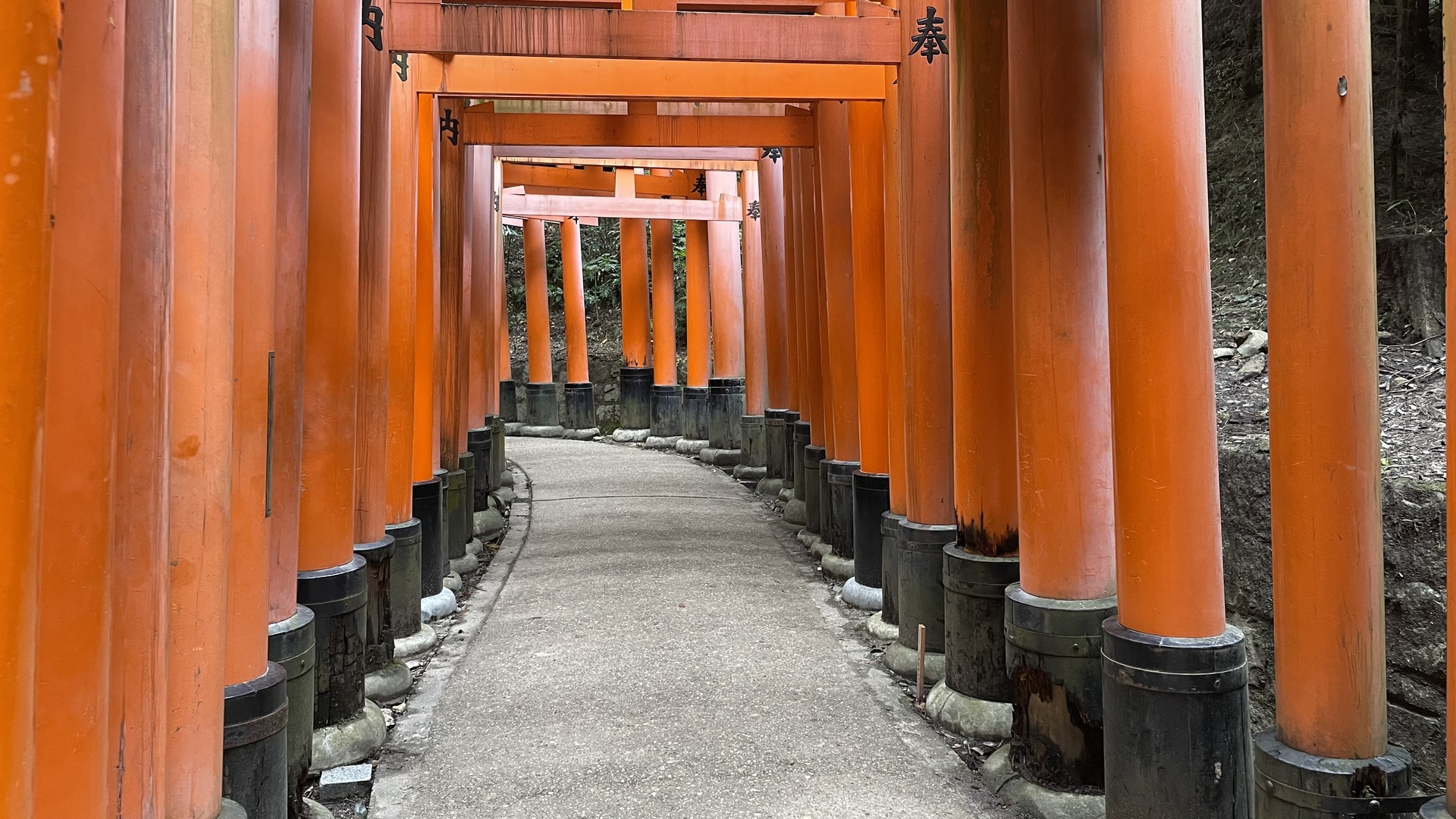
Kyōto :: Fushimi Inari-Taisha
Fushimi Inari-Taisha 伏見稲荷大社 is the main Shintō shrine of Inari, the principal and highly regarded goddess (kami) of fertility, rice, and blacksmiths, and in modern times also of agriculture and industry overall. Foxes are treated as messengers of the goddess Inari, especially the white ones called kitsune, believed to possess supernatural powers. Situated a bit outside the town but well connected, it consists of a shrine at the base of a hill and rows of numerous mostly red torii gates placed over paths leading to the hill top well above the town (ca. 4 km altogether, ca. 200m height difference). Small fox statues are everywhere, some with message scrolls in their mouths. Extremely photogenic and—no wonder—overcrowded, but with the density of visitors diminishing with every step uphill. By the way, there are numerous similar Inari shrines spread all over Japan, but this one is by far the largest.
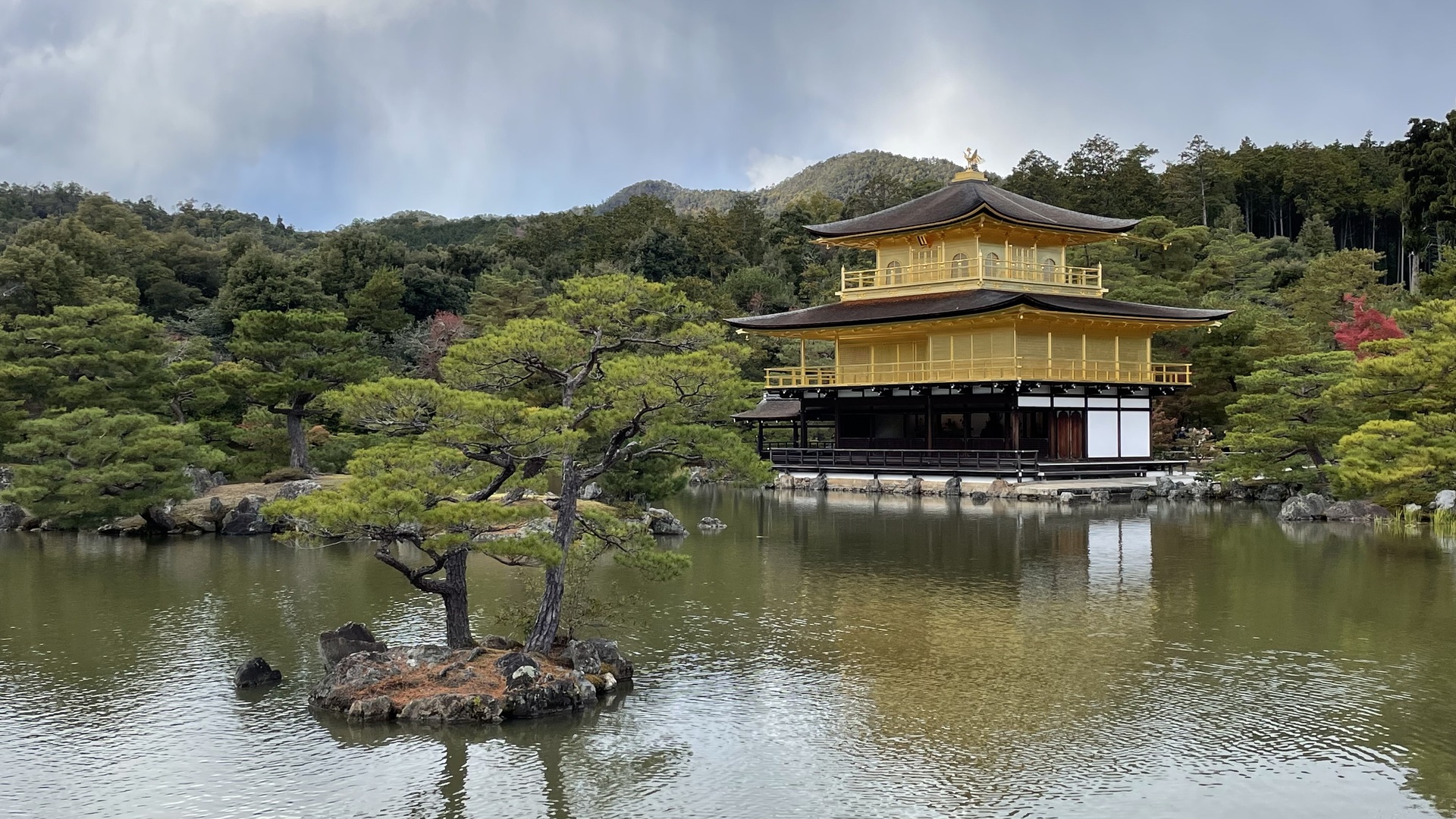
Kyōto :: Kinkaku-ji
Kinkaku-ji 金閣寺 was a kind of tourist trap. We arrived by public transport (all the way from Fushimi Inari-Taisha by train, bus, and then on foot), only to land at a huge bus parking area full of groups from all over the world, queuing for entrance tickets. What followed was an exercise in how to behave in an overcrowded tourist destination—an experience of its own, especially because of the weather, with sporadic glimpses of the sun, and the resulting photographic challenges. Anyway, moving against the prescribed visiting direction was a challenge. In all these crowds, one easily forgets what it is all about. The world-famous Golden Pavilion (covered with a layer of thin gold leaf) was erected in its present form in the 14th century by Ashikaga Yoshimitsu, a retired shōgun building it as a kind of memorial, amid a lush garden and over a pond that reflects it beautifully. It is said to represent the height of the art of that time, known as the Muromachi period, with its flourishing culture and arts, including the development or refinement to perfection of the tea ceremony, Zen Buddhism and wabi-sabi aesthetics. Typically for the philosophy of that this era, the gold covering is supposed to mitigate and purify any pollution or negative thoughts and feelings toward death, see wikipedia. It was also the site of a specific crime in 1950: a novice monk “unable to bear the beauty of the pavilion” set it on fire and managed to burn it down during the night before attempting suicide. Although diagnosed with schizophrenia, he received a harsh sentence, only to die soon after being conditionally released due to his serious mental illness. The building was rebuilt—reborn like the phoenix from the ashes adorning its rooftop—using a somehow much thicker gold layer as the original one, with some 20 kg of gold applied…
[With this immense Kinkaku-ji crowds experience, we gave the nearby Ryōan-ji 龍安寺 Zen temple with its all-too-famous Hōjō-Teien stone garden, up and took a bus to Daitoku-ji instead.]
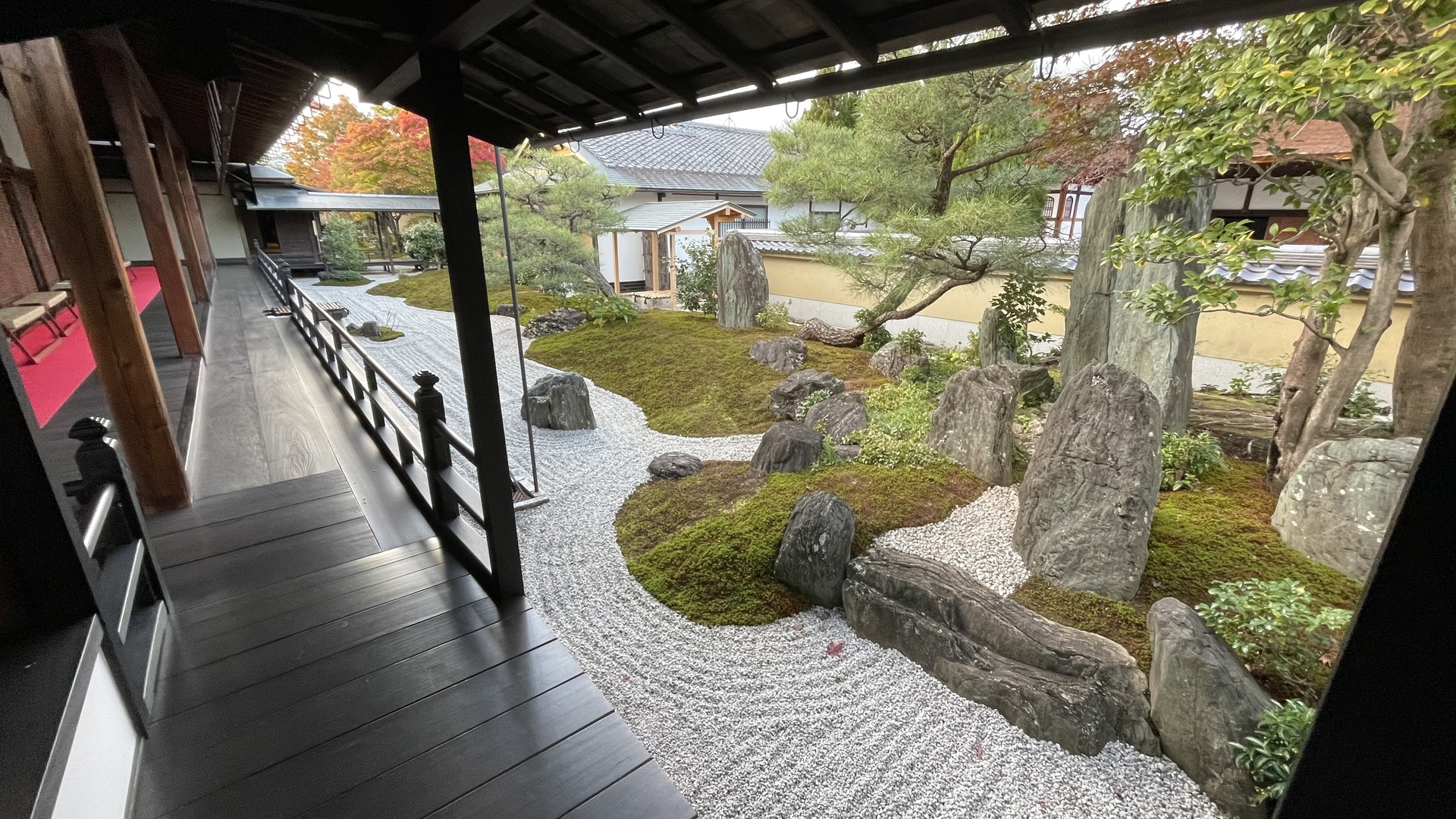
Kyōto :: Daitoku-ji :: Ōbai-in
Daitoku-ji 大徳寺, a large complex of several temples and monasteries belonging to the Rinzai school of Zen Buddhism, where you can spend the whole day visiting; for the full list and descriptions see wikipedia. We managed to visit two sub-temples there: Ryōgen-in 龍源院 and Ōbai-in 黄梅院; see the separate detailed post by Jacek. Another highly recommended, but not necessarily well known sub-temples are Kōtō-in 高桐院 for its intense Zen garden (was closed) and Jukō-in 聚光院 for its painted fusuma sliding doors.
Kyōto :: Nanzen-ji :: Tenju-an
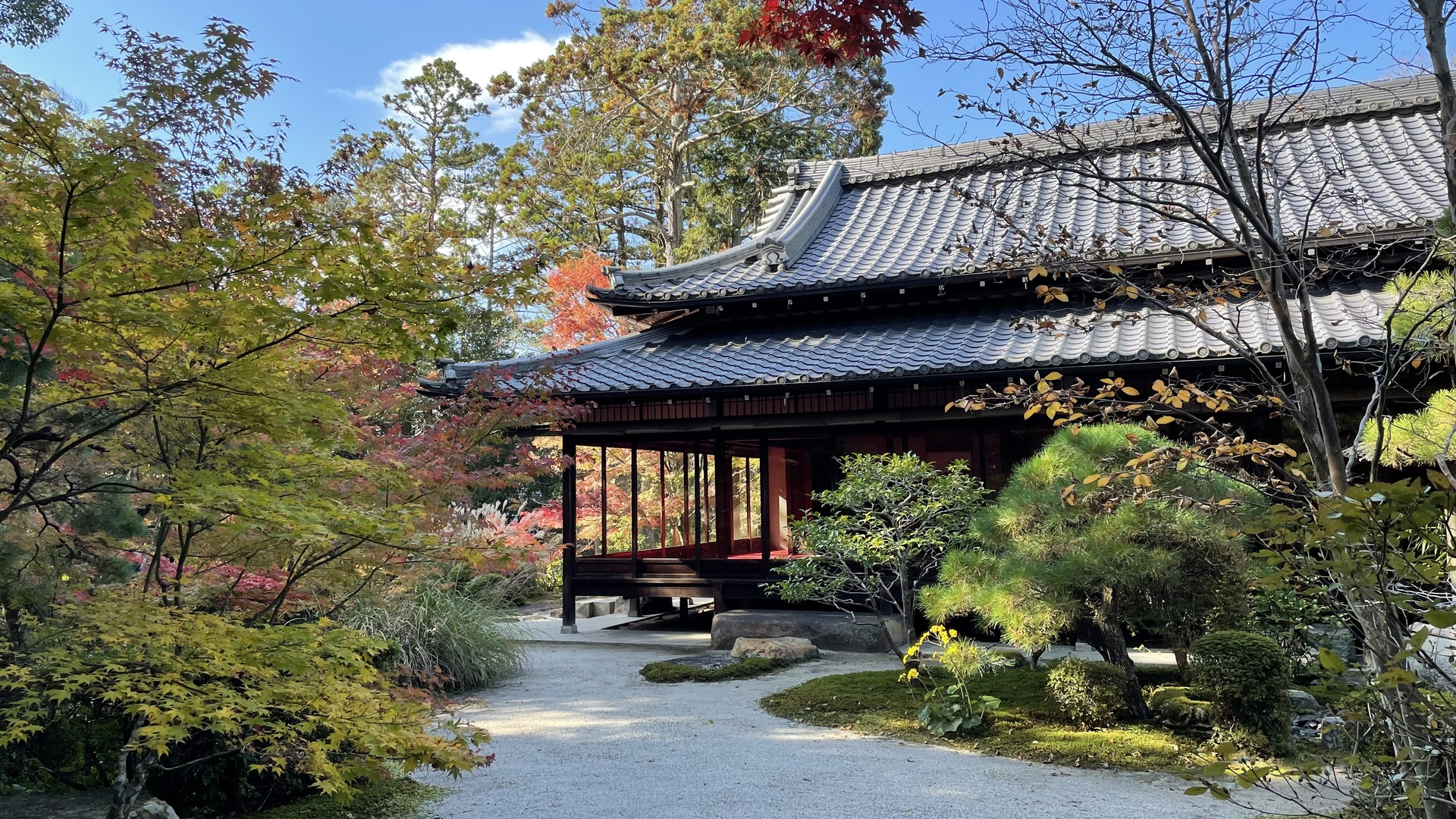
Nanzen-ji 南禅寺 is a larger Rinzai Zen temple dating from the 13th century, with a number buildings in beautiful gardens spread at the exit of a green valley. Situated near Suirokaku, an important aqueduct transporting drinking water from Lake Biwa to Kyōto, built in the Meiji era. It is an active Zen monastery with monks receiving their instructions daily all year round, including zazen. Actually, Nanzen-ji takes by tradition the supreme top place in the hierarchy of Rinzai Zen temples in Kyōto, historically playing a supervising role over other privileged top temples, the so-called Kyōto Five Zen Mountains, Gozan 五山. The large main entrance gate, San-mon, is a later addition from 1628, commemorating the victims of the Ōsaka Castle siege a few years earlier. The main building (hōjō) is complemented by a truly beautiful stone garden. It is worthwhile to make a walk deeper into the valley to reach a cave and a waterfall with a small hidden pilgrimage site of Nanzen-ji Oku-no-in 南禅寺 奥の院 as well as search through the area for sub-temples (thirteen of them altogether!), although they might have very specific opening hours if not closed to the public, used for the quiet zazen sitting meditation. Especially recommended: Konchi-in 金地院 with a renowned stone garden (not visited!…) and Tenju-an 天授庵, both below an overgrown hill slope southwest or south of the main Nanzen-ji buildings. Tenju-an features two atmospheric Zen gardens: a stone and a pond garden. Very photogenic!
Kyōto :: Eikan-dō
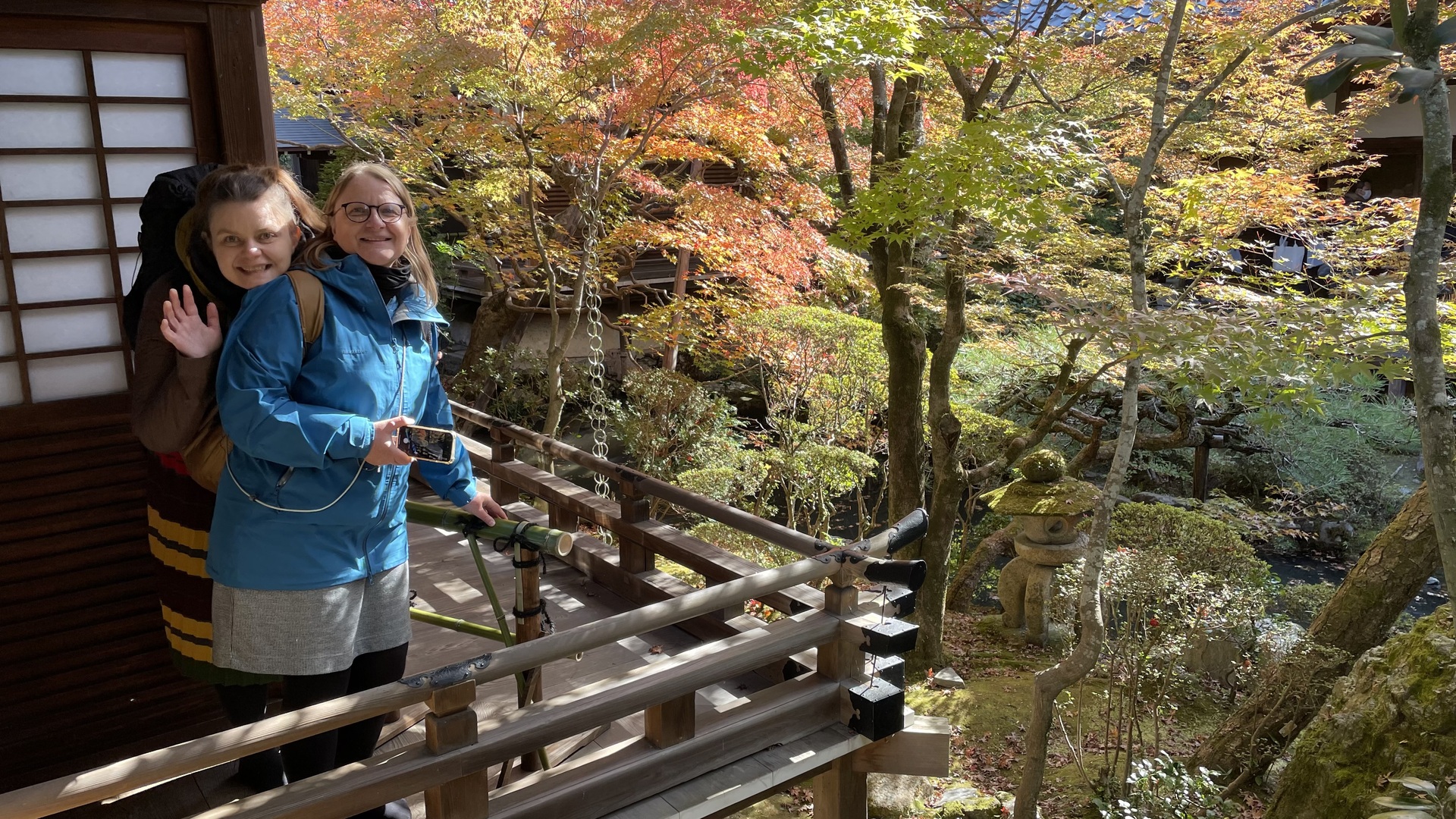
Eikan-dō 永観堂, vel Zenrin-ji 禅林寺, shows all the features of a headquarters temple—in this case of the Seizan, just another branch of Japan’s original Jōdo-shū (“Pure Land”) school of Japanese Buddhism (and not Zen, despite the name). Very representative, a lot of golden altars, with curtains adorned with the sect logo hanging all around the entrance to the main hall. All in all, a very impressive temple surrounded by lush gardens on a hillside and definitely worth a visit. It is recommended to climb to the tahōtō—the temple tower with a view of the town. Wikipedia.
Tetsugaku-no-Michi 哲学の道 (Philosopher’s Walk) is a path along a water channel running below the hills by the western edge of Kyōto’s northern Higashiyama district, named so because the philosopher Kitaro Nishida is said to have practiced walking meditation here. Anyway, a very practical junction path for visiting the temples by foot. Surrounded by cherry trees, recommended especially in spring…
Reikan-ji 霊鑑寺, at some distance above the Philosopher’s Walk, is open to the public only for the first two weeks of April and the last two weeks of November, which seems to be typical for an active Rinzai Zen nunnery and temple. It is famous for the surrounding natural gardens, with camellias blossoming in spring and red maple trees in autumn, and this explains the specific opening times. In the past, the abbesses of the nunnery were princesses from the imperial family, and the temple is actually an adapted small imperial palace. Built in 1654, it is said to be one of the most original temples from the Edo period surviving. We had the rare luck to be allowed to enter, however the precious paintings were not to be seen.
[Passed by Hōnen-in 法然院 without entering. It seems that the buildings of the temple is rarely open to the broad public for visits (two times a year, check the temple website), with its main role as a place for funeral ceremonies (a cemetery nearby) and specific community cultural events. However, the entry to the surrounding temple ground is free. Named after Hōnen, the founder of the early original Jōdo-shū Buddhist school, but since 1953 declared an independent Buddhist temple.]
Kyōto :: Ginkaku-ji
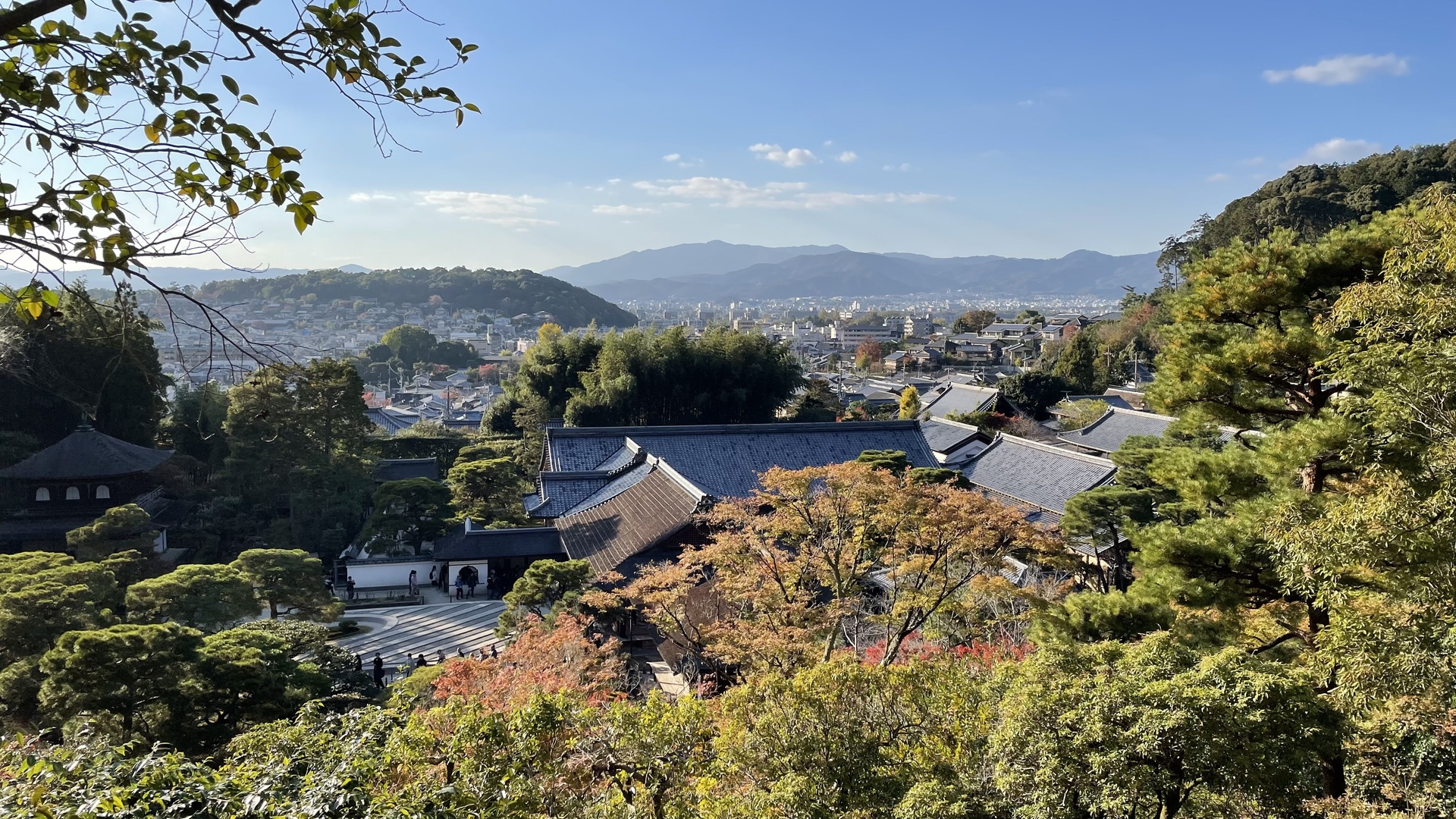
Gingaku-ji 銀閣寺, usually known as the “Silver Pavilion,” was founded in the 15th century by the same shōgun clan, Ashikaga, as in the case of “Golden Pavilion,” Kinkaku-ji (see above). This time shōgun Ashikaga Yoshimasa, the grandson of the Golden Pavilion’s builder, built himself a retirement place on the opposite slope of the broad Kyōto valley. His residence as a retired shōgun was turned into a Zen temple named Jishō-ji just after his death, as was quite customary at that time. Being the most representative example of the so-called Higashiyama culture, it has a large historical, artistic and cultural value to the Japanese society. Presently, it belongs to the Shokoku-ji branch of Rinzai Zen. In contrast to the Golden Pavilion, the Silver Pavilion was never covered with silver but with lacquer instead—and, as in the case of the Golden Pavilion, a phoenix decorates its rooftop. This unfinished feeling is fully consistent with wabi-sabi aesthetics; however, the real reason was the lack of funds and interest connected with the ongoing catastrophe of the Ōnin War, which opened the destructive Sengoku period of Japanese history. The beautifully designed garden can be visited by following a path over bridges to a spring and a waterfall on the slopes of a hill overlooking the temple. There is also a remarkable stone garden with sand stripes featuring different patterns and textures, and with a famous conical pile of sand named kogetsudai 向月台, said to represent Mount Fuji. Wikipedia.
Kyōto :: Tōfuku-ji
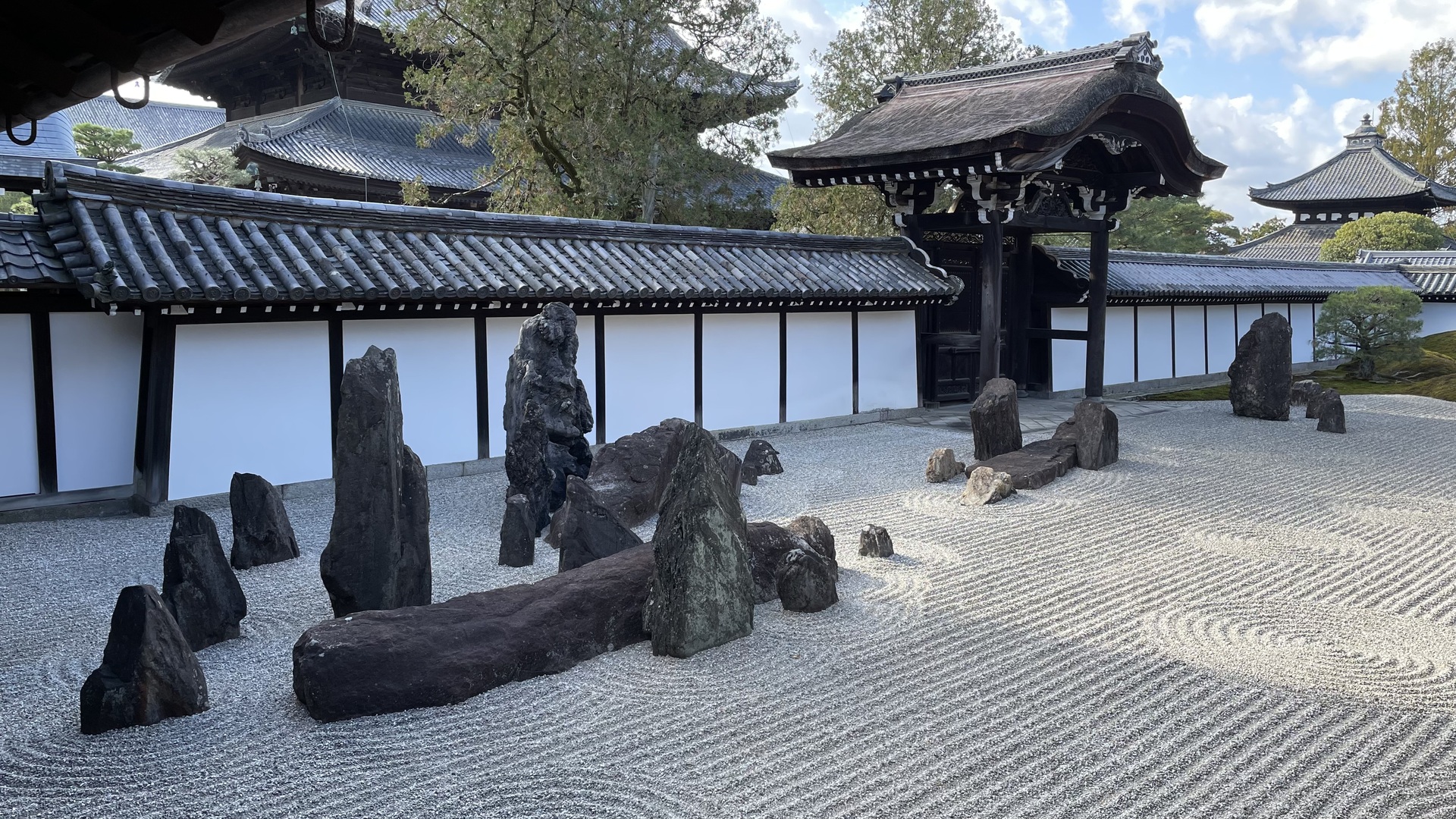
Tōfuku-ji 東福寺 is a very large temple complex southeast of the city center, the headquarters of the Rinzai Zen school. The temple dates from the 13th century, but most of the present buildings are from the 15th. The outer and inner architecture is said to reflect the Chinese roots of Zen Buddhism, with monks extensively visiting Chinese monasteries in the 13th century. Once belonging to the privileged top temples, the so-called Kyōto Five Zen Mountains, Gozan 五山, the temple was strongly diminished during the predominantly anti-Buddhist Meiji era — even temporarily becoming a prisoner camp for captured Russian soldiers in 1904–05. The Tsūtenkyō Bridge over a small gorge, surrounded by a sea of Japanese maple trees, is a prime destination for momijigari in Kyōto, but there is an abundance of these photogenic trees everywhere around the temple. The stone gardens surrounding the main hall (hōjō) on all sides are among the most revered in Kyōto, designed and realized in the 20th century with “modern” features such as a tile-like moss garden. What we missed, following the prescribed visiting route, are numerous sub-temples spread across the large grounds, some of them very interesting. Temple website.
Kyōto :: Sanjūsangen-dō
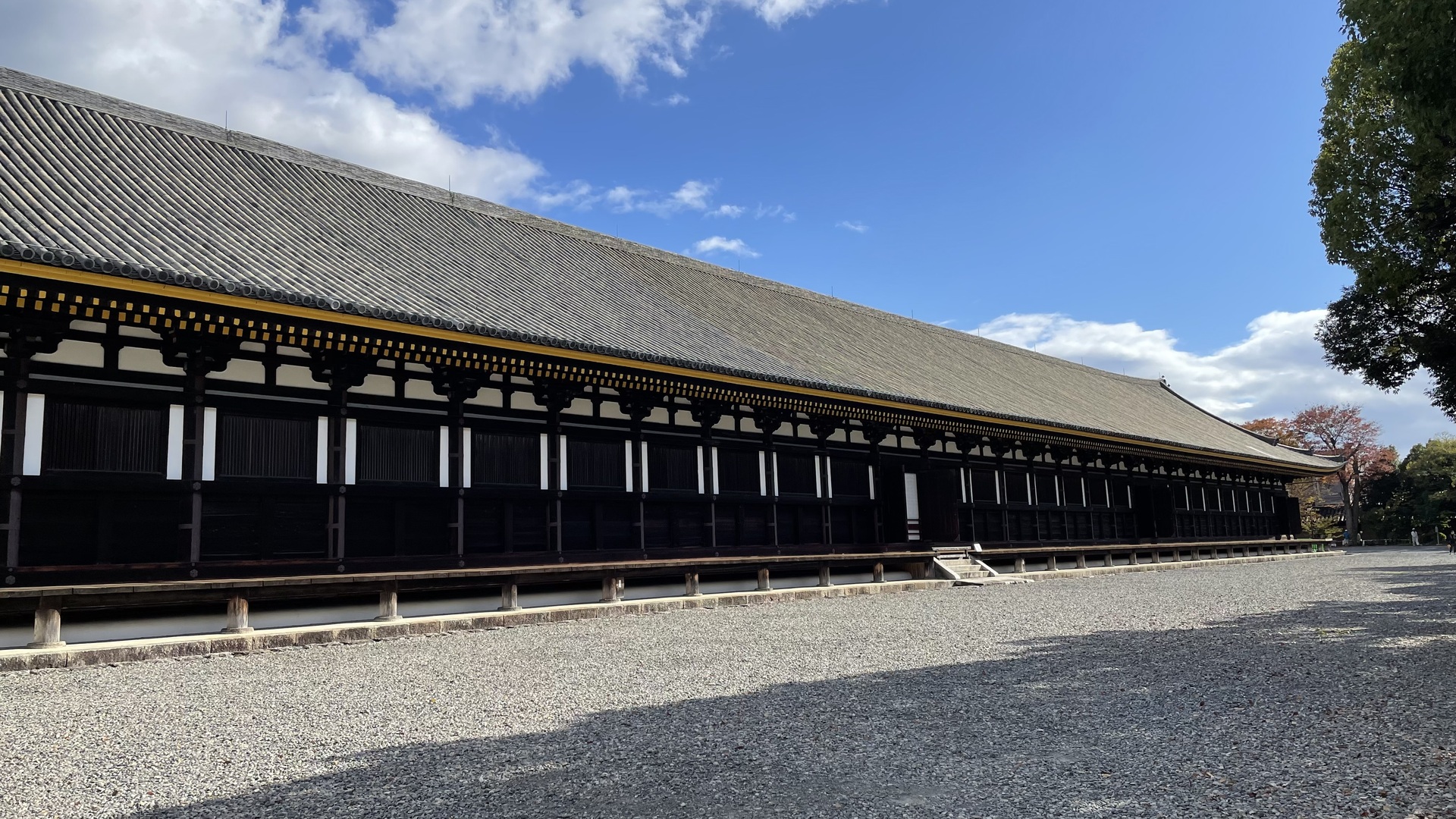
Sanjūsangen-dō 三十三間堂 is a long and large hall (divided into 33 sections, hence the numeric name), which surprisingly survived the Ōnin Wars that devastated Kyōto thoroughly, with the present building dating from 1266. The hall contains one large and 1000 smaller thousand-armed Kannon statues in neat rows, each said to be different, with 28 other Buddhist deities placed in front of them. Very photogenic—were it allowed to take photos inside, which is strictly forbidden. The temple is famous for its Tōshiya archery competitions in several popular categories, as well as master-class events in which arrows must pass in a straight line along the narrow spaces between beams supporting the long roof of the hall. Scars on the beams and, in some places, arrowheads left in place are witnesses to failed shots. The archers must appear in traditional attire, which makes the much-frequented female competition a kind of sport kimono festival as well (second Sunday of January). Temple website with photos of the Kannon statues.
Nishiki Market 錦市場 is a central and, although in a modern setting, mostly very traditional market in Kyōto. Numerous businesses of all kind line a 400 m roof-covered narrow street running east–west, a delight or nightmare for all your senses. With all Kyōto specialties available, it is not only a tourist magnet but also a regular market for local residents. The eastern end of the covered market T-joins another, much wider and modern covered shopping arcade, Teramachi Street (running north–south). A kind of shopping paradise.
Kyōto :: Tenryū-ji
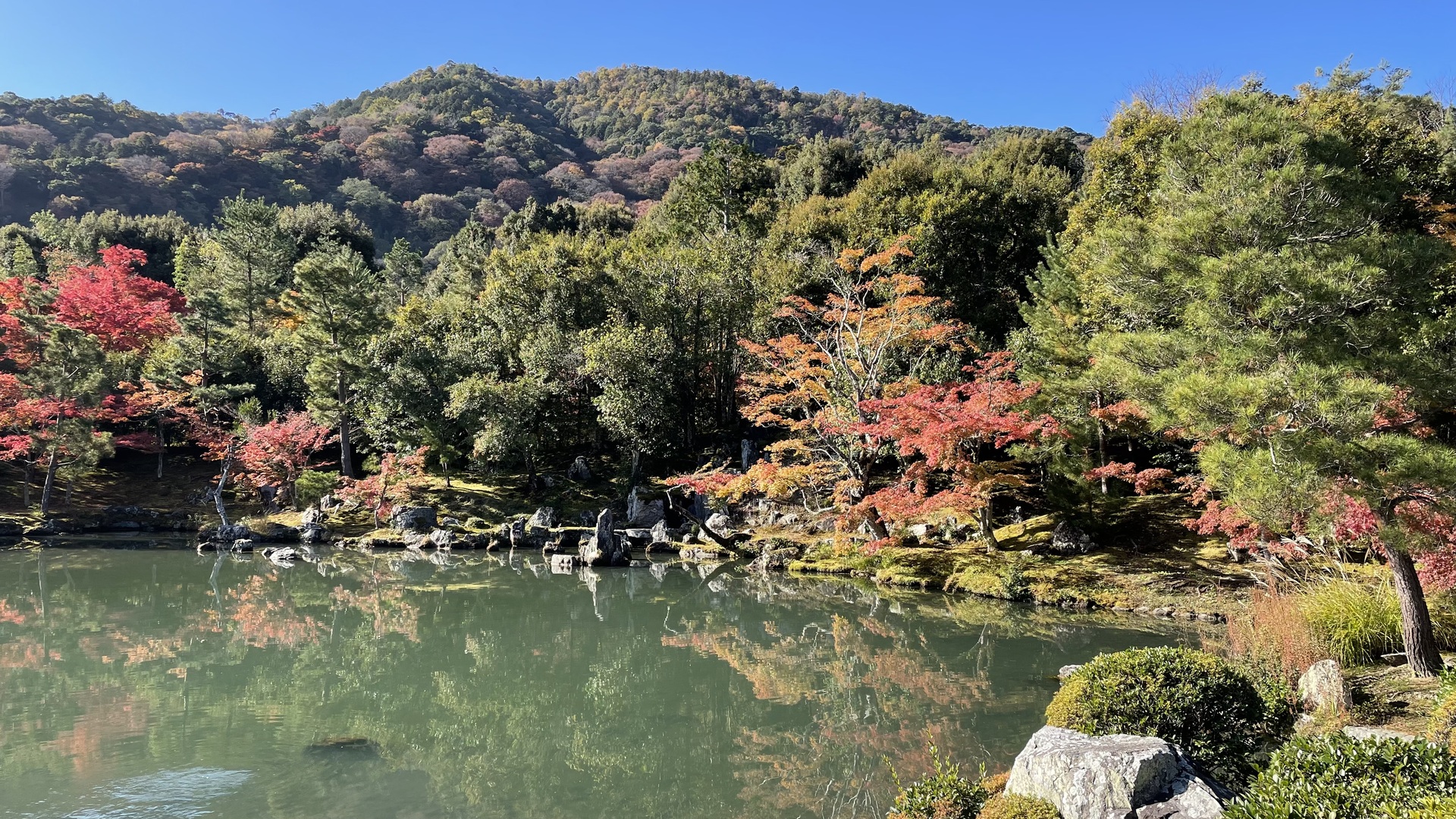
Tenryū-ji 天龍寺 belongs to a branch of Rinzai Zen Buddhism bearing the same name as the temple—Tenryū-ji—being, of course, its headquarters. It was established in the 14th century as a palace named Kameyama (“turtle mountain”), built on the site of an even older temple. This explains the recurring turtle theme, with the alternative name Reigizan 霊亀山 (“spirit turtle mountain”). Supposedly, the shape of the mountain towering above the temple (Mount Ogura) resembles a turtle. Due to the tourist popularity of the Arashiyama neighborhood, it is often frequented by pass-through visitors arriving by train at the nearby station and heading to the famous bamboo grove, but it can easily be a destination of its own, being one of the most revered temples in Kyōto, historically belonging to the privileged top Rinzai Zen temples, the so-called Kyōto Five Zen Mountains, Gozan 五山. The elegant garden is a classical example of shakkei (borrowed scenery), with the slopes of “Turtle Hill” forming the natural backdrop. One of the most popular buildings (separate tickets required) is a hall with a Unryū-zu 雲龍図 painting on the ceiling, depicting a dragon emerging from clouds whose eyes seem to follow you wherever you stand. Actually, the name of the temple means “heavenly dragon”. Due to numerous fires, most of the present buildings date from the 19th and 20th centuries, with only the garden surviving from the 14th. Wikipedia.
Arashiyama bamboo grove 嵯峨竹林 is an extremely overcrowded alley in a highly instagrammable bamboo forest just behind Tenryū-ji. There are numerous other bamboo groves in Kyōto, we have visited at least three-four of them (especially recommended in Kōdai-ji in Higashiyama and Adashino Nenbutsu-ji nearby), not to mention elsewhere out of the town, but this is the one where you are obliged to take a selfie and publish it online within seconds. And everyone knows it should be empty by sunrise… No chances, it empties only after sunset.
Kyōto :: Ōkōchi Sansō
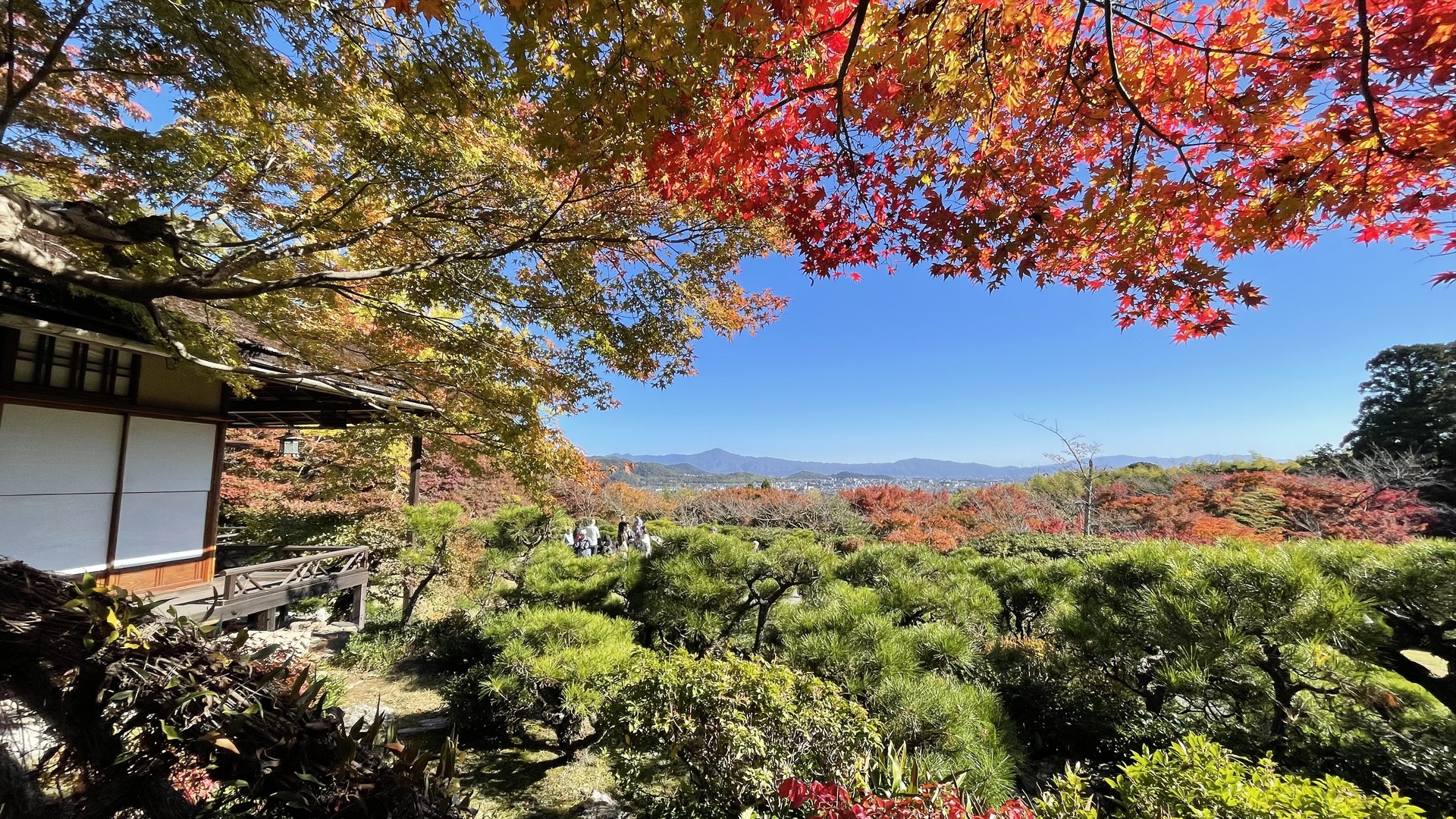
Ōkōchi Sansō 大河内山荘 is a villa in spacious surroundings above the Arashiyama bamboo grove. It once belonged to the Japanese silent-movie star Denjirō Ōkōchi, who designed the property in a very traditional Zen style with a large dose of perfectionism—tea pavilions, stone lanterns, red momiji leaves covering moss surfaces below maple trees, etc. The property is presently open to the public. The surroundings are partly natural, partly garden, a sensory delight for momijigari lovers, with far-reaching views over Kyōto towards Mount Hiei and in the opposite direction down the Hozu-gawa river gorge (boat excursions).
Kyōto :: Jōjakkō-ji
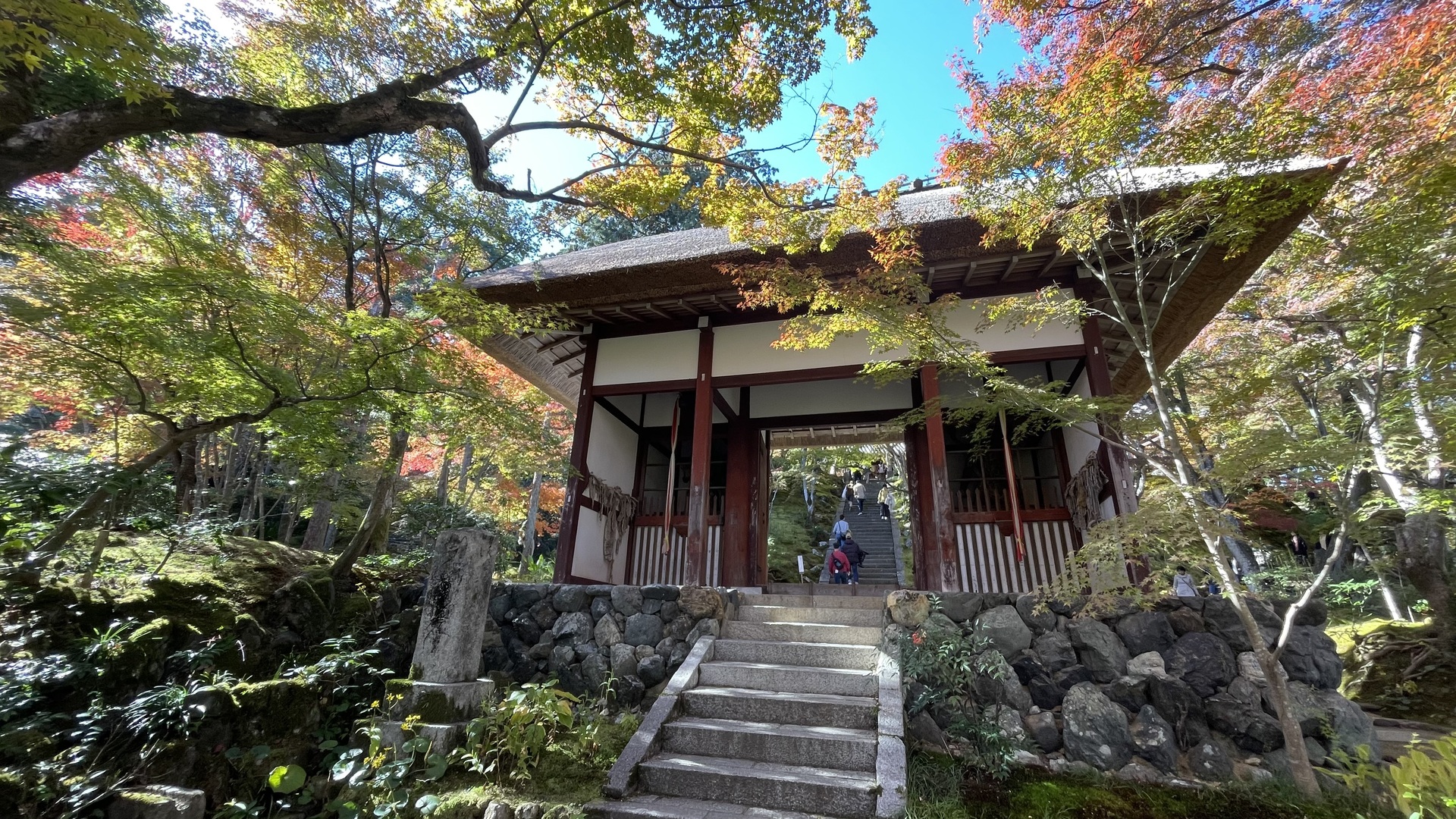
Jōkkakō-ji 常寂光寺 is a temple of the Nichiren branch of Japanese Buddhism, founded by the Nichiren priest Nisshin at the turn of the 16th and 17th centuries on the slopes of Mount Ogura, at the site of a previously existing aristocratic residence. It consists of several pavilions scattered on the slopes, the most characteristic being a photogenic tahōtō pagoda with a view of Kyōto below. Usually a quiet place, it enjoys more visitors in autumn when the foliage explodes in color, with red maples leading the way. The oldest building is a humble thatched entrance gate surrounded by maples. A short walk along paths on the slope, covered with lush vegetation, is probably the most enjoyable activity here. The temple’s website provides all necessary details.
[Nison-in 二尊院 was unfortunately omitted; Tendai sect. We entered the gate only to give up in order to have enough time to visit the temples further north. It seems to be a very elegant temple connected to the imperial court, with three tombs of emperors and precious religious statues. See wikipedia.]
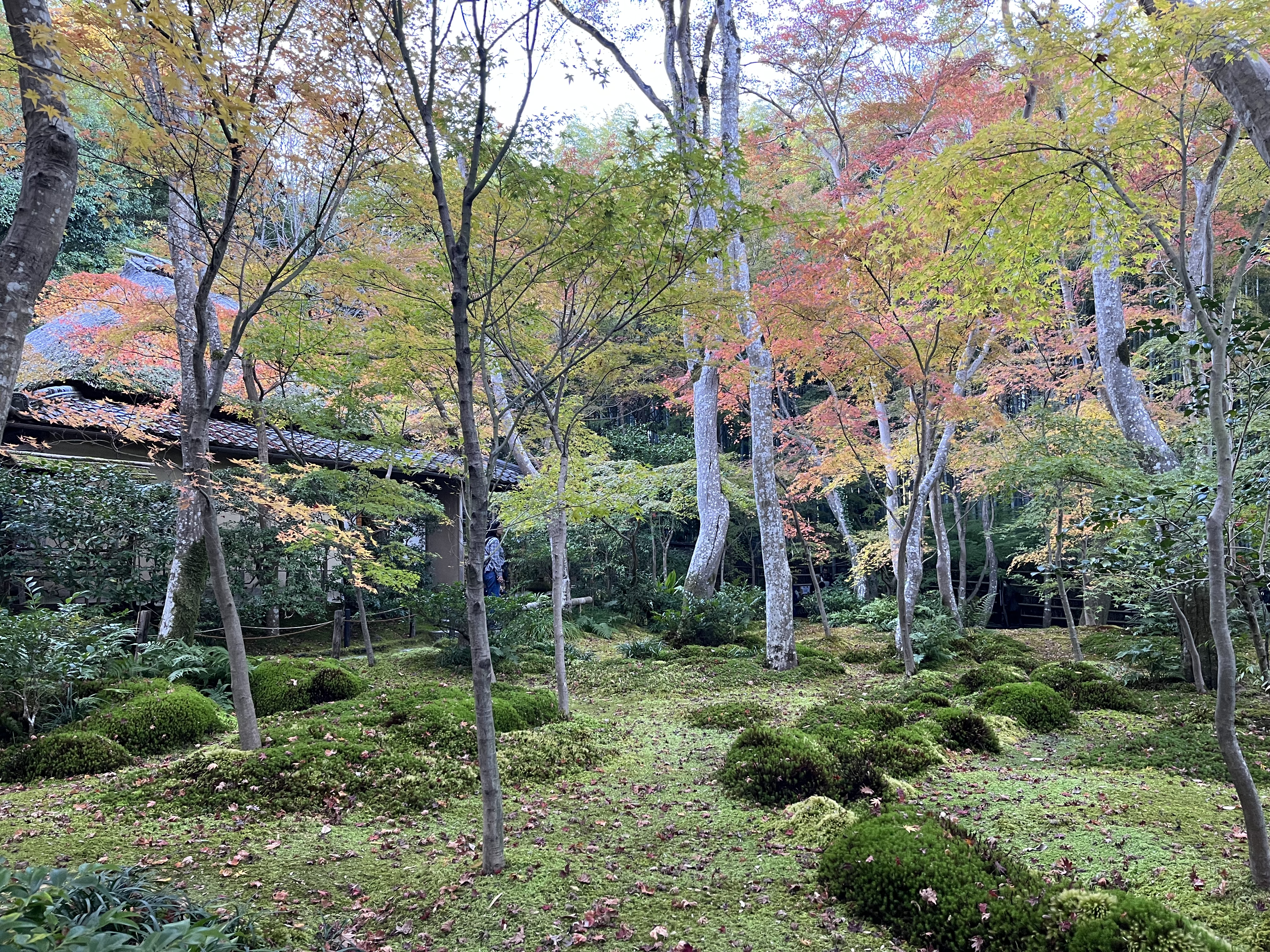
Kyōto :: Giyō-ji
Giyō-ji 祇王寺 is a nunnery with more legends than known historical facts… Situated in a previous temple precincts which was thoroughly destroyed during the Ōnin Wars. Named after a dancer (or geisha?) who became a nun here, Giyō, it was restored from neglect in the late 20th century by another ex-geisha, Chishoni, a known personality in Kyōto, with the support of Daikaku-ji. This is a very humble place compared to other temples in Kyōto, with only one simple pavilion. Its most distinctive and remarkable feature is a beautifully maintained, truly exquisite moss garden. Visitors are encouraged to distinguish between various moss species while visiting the garden (on display before the pavilion).
Takiguchi-dera 滝口寺 can be quickly reached from Giyō-ji by a path up the hillside covered with maple trees. Only one quite large pavilion and a ticket booth, manned by a retiree providing the visitors with goshuin of the temple. A small cemetery is present, with one of the stones connected to a tragic love story—discover it yourself!
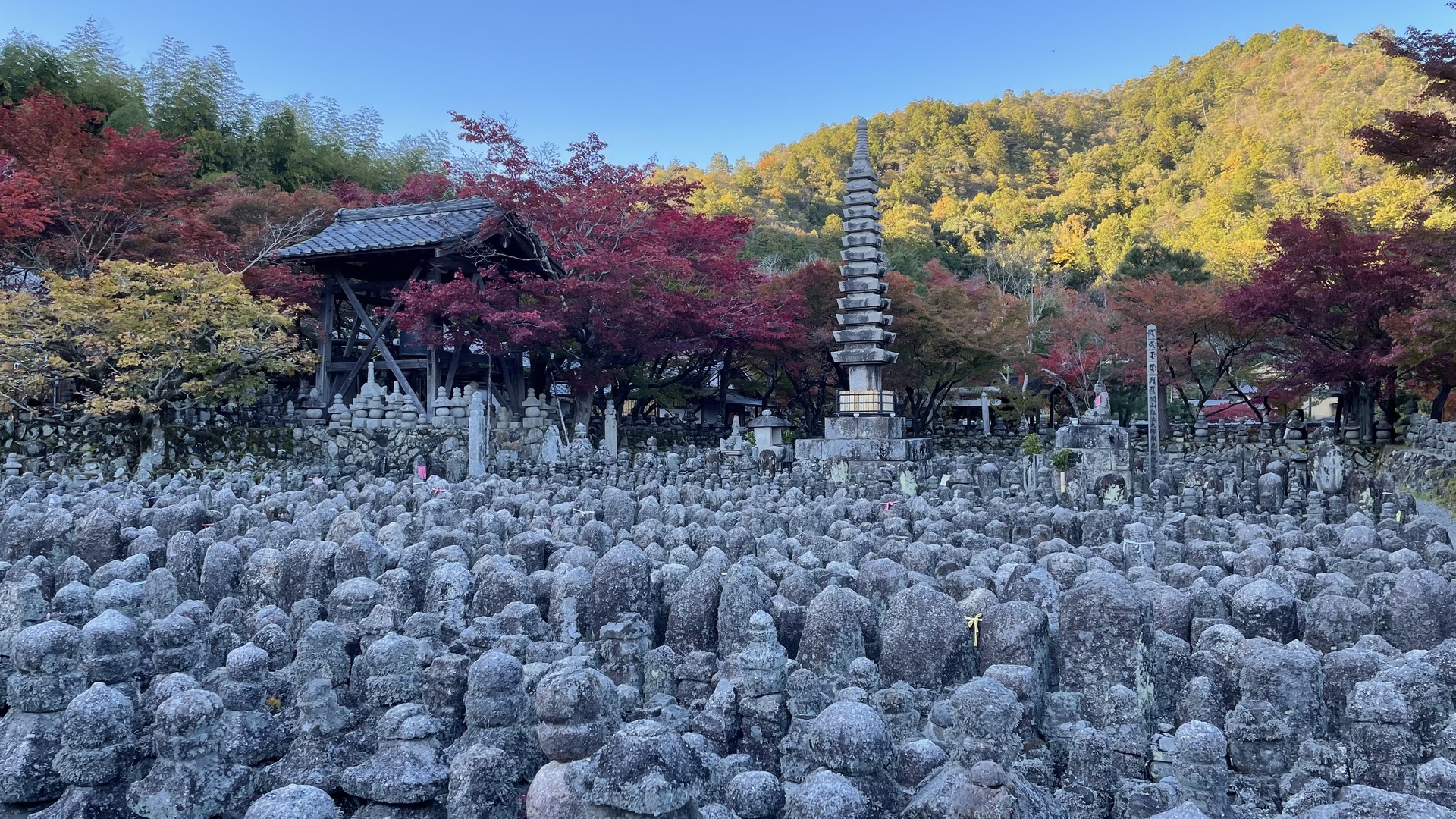
Kyōto :: Adashino Nenbutsu-ji
Adashino Nenbutsu-ji あだし野念仏寺, with “Adashino” referring to the place and “nenbutsu” describing the practice of continuous mantra recitation. By tradition, it is assumed to have been initiated by Kūkai, the grounder of the Shingon sect of Japanese Buddhism in the 8th century. The temple is located on a site used in the past for funeral purposes, where bodies—especially those of unknown dead without kin to care for them—were abandoned to the elements. This in the deep past; later, the place served as a cremation site, with gravestones scattered throughout the overgrown area. At the beginning of the 20th century, the gravestones, some in the form of Jizō statuettes (in the role of the bodhisattva caring for the souls of the unknown), were collected in one place, forming an impressive field of over 8,000 monuments. On the last weekend of August, the temple hosts sento kuyo ceremonies dedicated to the spirits of the (unknown) dead, with thousands of candles lit all over the area. Wikipedia
Atago Torii 愛宕神社 一の鳥居 (formally Atago Jinja first torii gate) marks the northern end of the most frequented tourist path along the hills of Arashiyama, with a practical bus stop nearby. Just behind the gate is an original old tea house, Ayuchaya Hiranoya 鮎茶屋平野屋—a perfect place for a cup of tea with obligatory sweets. The tea house also serves as a fancy restaurant even offering full kaiseki meals if required.
[Notice for future visits: a few hundred meters further north along the road is a mostly 20th-century forest temple of a unique character, Otagi Nenbutsu-ji 愛宕念仏寺, with 1,200 distinctive stone statues representing Buddha’s disciples, some of them old, and some very(!) contemporary… Recommended reading. Otagi-ji web site.]
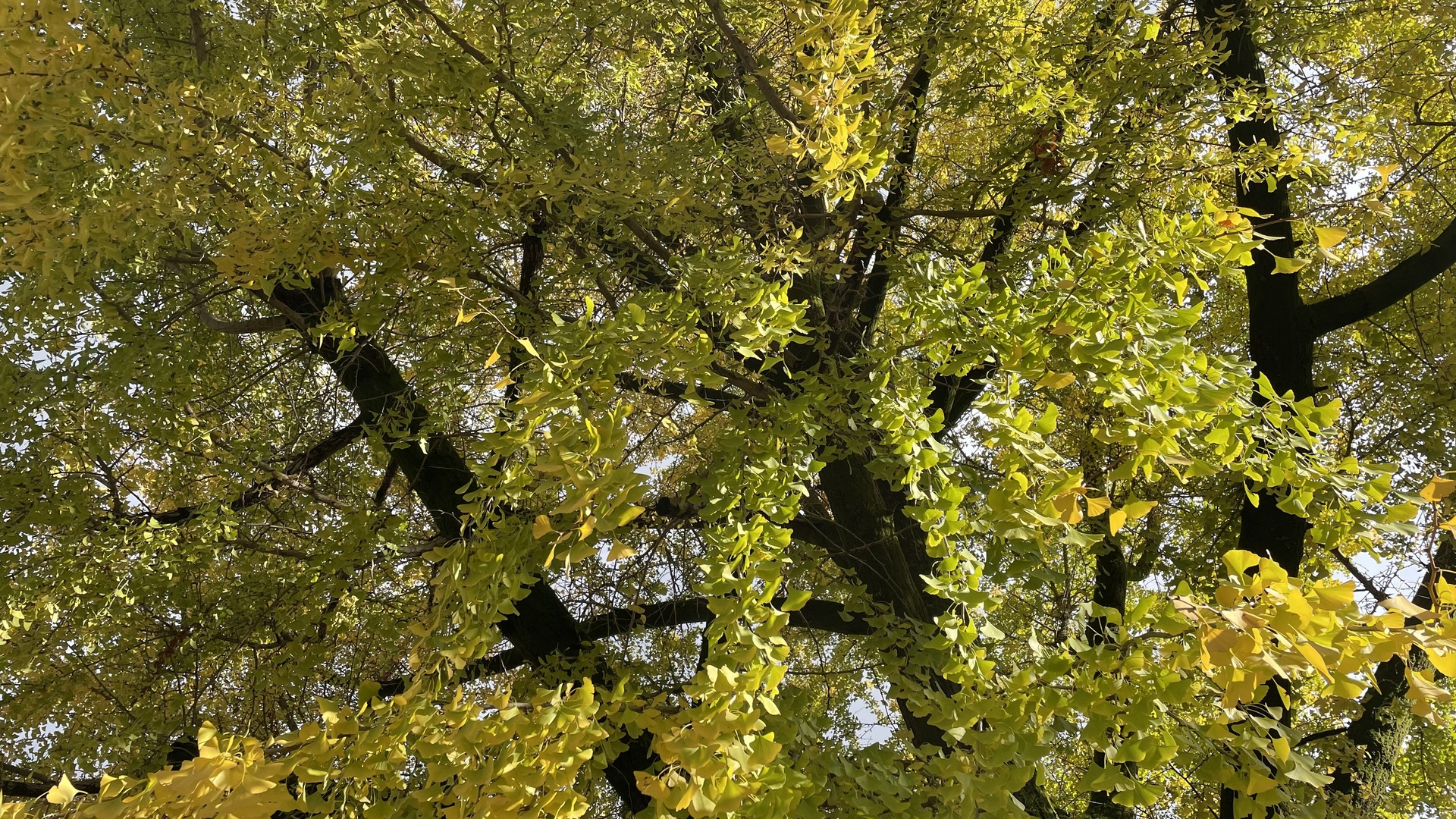
Kyōto :: Nijō-jō :: a gingko tree
The realized itinerary
Yes, of course, as the practice shows, the “done” itinerary always differs from the one planned. I include in square brackets what we had loosely planned before, but [did not visit]. in bold font points of interest described above. Here it is:
- 15 Nov 2023 Wednesday : Landing at Ōsaka KIX airport, then JR Haruka Line (1h15min) to Kyōto, Higashi Hongan-ji (closing time…), Shosei-en Garden (already closed…), Gyoza restaurant Cho cho gyoza.
- 16 Nov 2023 Thursday : Southern Higashiyama: Kiyomizu-dera, over Shinnen-zaka & Ninnen-zaka neighborhoods to Entoki-in (only garden), Kōdai-ji, Maruyama-Kōen Park with Yasaka Jinja, Chion-in, Shōren-in, then walk down to Gion, an izakaya there, then walking along the Pontō-cho street home.
- 17 Nov 2023 Friday : Nishiki Market breakfast, transfer via metro to Nijō-jō Castle [Kyōto Imperial Place excluded], transfer with metro to Higashiyama, MoMaK (National Museum of Modern Art), crafts shop by Heian-jingū, udon restaurant nearby, bus to the center, home by foot.
- 18 Nov 2023 Saturday : By train to Fushimi Inari-Taisha, from there transfer by train and bus to Kinkaku-ji, [Ryōan-ji with its stone garden given up], transfer by bus to Daitoku-ji complex, and there: Ryōgen-in, Ōbai-in. Transfer by bus to the center, another Cho cho gyoza restaurant.
- 19 Nov 2023 Sunday : Northern Higashiyama: Nanzen-ji with Tenju-an, later Eikan-do, and on along the Philosopher’s Walk (Tetsugaku-no-Michi), a side trip up to Reikan-ji, [passed by Hōnen-in], Gingaku-ji. transfer by bus to Kyōto Station (there: Skyway, Skygarden), omurice restaurant, shopping.
- 20 Nov 2023 Monday : By train to Tōfuku-ji, again train transfer to Sanjūnsangen-dō, by foot Nishiki-market, shopping in Teramachi.
- 21 Nov 2023 Tuesday : Transfer to Arashiyama (W): Tenryū-ji, Bamboo Grove, [Togetsū-kyō bridge missed], Ōkōchi Sansō, Jōkkakō-ji, [Nison-in not entered], Giyō-ji and Takiguchi-dera, Adashino Nenbutsu-ji, Atago Torii. A short visit in Hiranoya tea house. [No time for Otagi Nenbutsu-ji.] Transfer by train and metro homewards, local izakaya (oden, sake) nearby our accommodation.
- 22 Nov 2023 Wednesday : Bus direct to Kōya-san (2h30m), temple stay (shukubō) in Shōjōshin-in.
Link to the gallery of pictures illustrating our itinerary description.
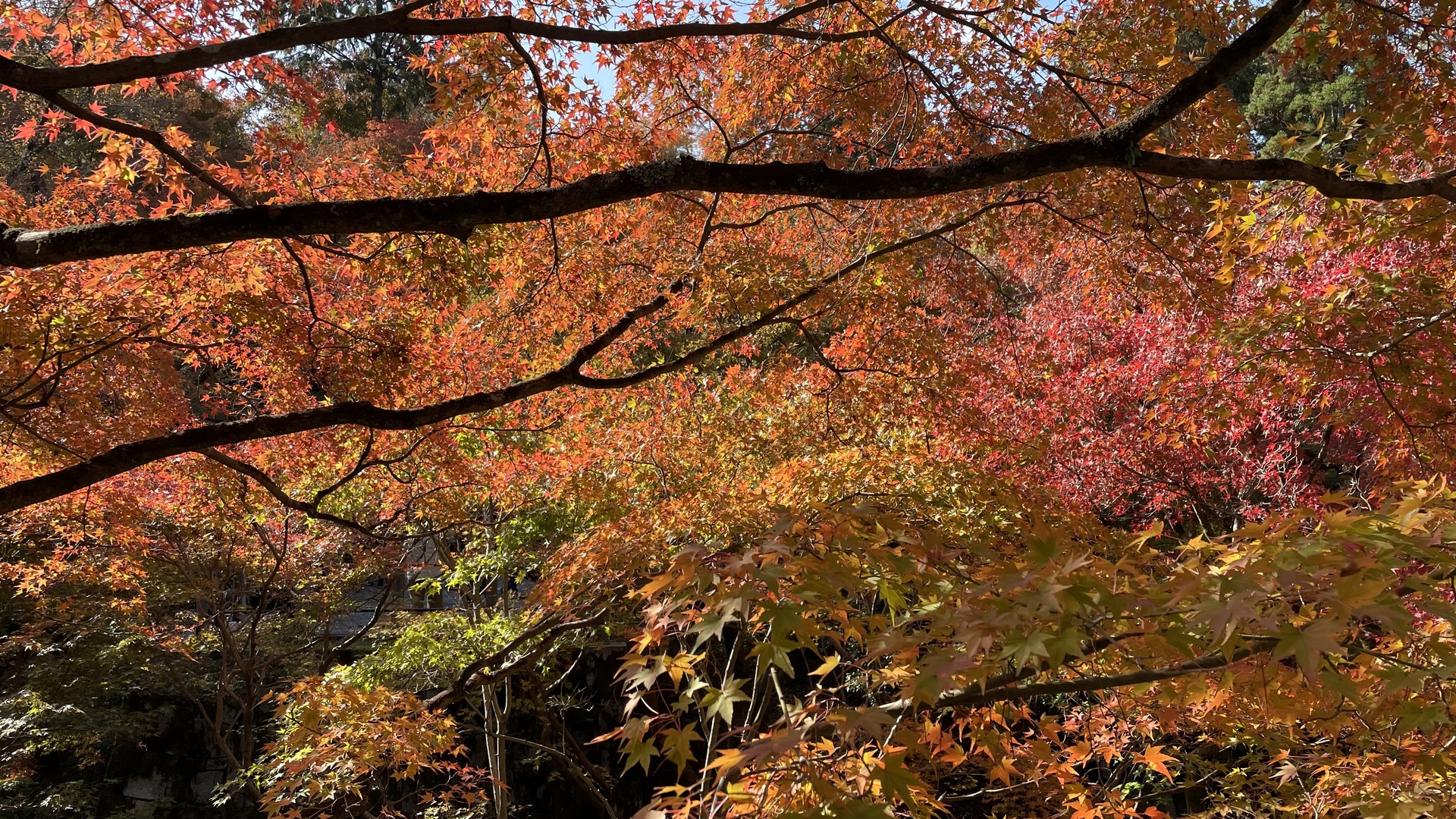
Kyōto :: Tōfuku-ji :: Japanese maple trees