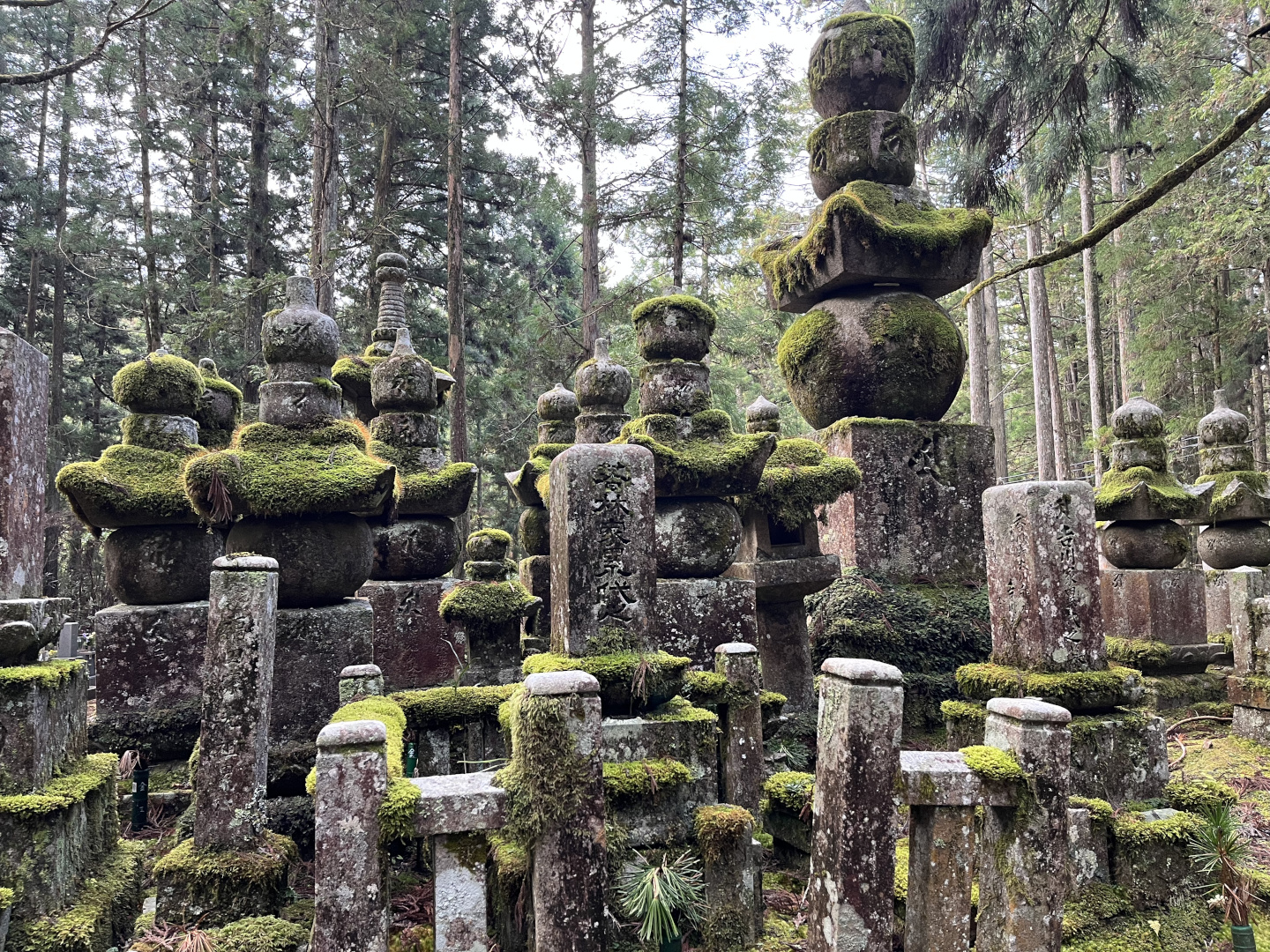
Three nights in the holy mountain site of Kōya-san 高野山. Buddhist temples, monasteries, and an important mausoleum within a centuries-old cemetery in cedar woods of the Wakayama prefecture just south of Ōsaka and Kyōto.
In the year 835, the founder of the esoteric Shingon school of Japanese Buddhism, the most revered monk Kūkai, chose to leave this world — while meditating — in a cave hidden deep within the mountain forests of the Kii Peninsula south of Kyōto. With the support of emperors — who had just recently established Kyōto as their permanent residence — he was able to spread his teachings, build numerous temples, and finally became the opportunity to make Kōya-san his main place of activity.
The Kōya-san area, donated personally to him by Emperor Saga in 815, became soon his principal and final residence, a secluded valley high in the mountains, deep in the cedar forests. After his death, Kōya-san attained quickly the status of a holy site, with an ever-growing number of temples and monasteries and, accordingly, increasing numbers of visiting pilgrims. Families of the highest rank in Japanese society, Fujiwara, Taira, later Toyotomi, Tokugawa — not to mention the Imperial House — found it appropriate to make pilgrimages here.
Indeed, Kūkai — by then known as Kōbō Daishi (namely: the grand master who spread the dharma teachings)—is believed to remain in a state of meditative over-consciousness (samadhi) for centuries already, within a mausoleum (gobyō) built around the cave he occupies. In a truly esoteric manner, he is still attended daily by Buddhist priests, who bring him his favourable food and drink.
The Shingon as well as Tendai sects eventually became the dominant schools of Japanese Buddhism with holy sites in this specific remote region of Japan. Over time, however, they grew too secularized and politically influential for the taste of the aristocracy, additionally facing rivalry from other Buddhist schools and their lay followers. Known as the ikkō-ikki and hokke-ikki leagues (Jōdo Shinshū and Nichiren schools, respectively), they undermined the authority of the established esoteric schools. Shingon and Tendai became also remarkably powerful, also in a strictly military sense — and the samurai found the competition from the sōhei warrior monks outrageous and an intolerable offence for their ambitions.
Consequently, during the struggles for the establishment of the shogunate in the late 16th century, the fortunes of these Buddhist schools changed dramatically for the worse. Two major monastic complexes in the region were completely destroyed by the samurai — namely Negoro-ji and also Enryaku-ji on the Mount Hiei. Kōya-san, however, managed to avoid a similar fate by swearing unconditional loyalty to Toyotomi Hideyoshi in the very last moment before the final attack. This proved to be a fortunate decision, securing the support of the highest aristocracy and ushering in another period of prosperity for Shingon during the Edo era. Members of the most influential family clans made pilgrimages to Kōya-san; even the all-conquering Tokugawa shogunate found it fitting to establish a mausoleum for their deceased in the place. Oku-no-in, in the valley leading to Kōbō Daishi Gobyō, became probably the most prestigious Buddhist cemetery in the country.
The Meiji era, and the period leading up to the Second World War, brought a time of crisis for Kōya-san. With nationalist State Shintoism established as the only supported state religion and Buddhism strongly and sometimes aggressively suppressed, all over the country Buddhist temples and monasteries all were abandoned, some of them destroyed or burned down, and land holdings confiscated, leading to a gradual decline of Buddhism in Japan. Symptomatically, even parts of the ancient conifer forests in the Oku-no-in cemetery valley were cut down for profit.
Yet adaptation ensured survival. A degree of political opportunism—Shingon Buddhism being regarded as particularly loyal to the government—combined with pragmatic reforms such as allowing women pilgrims to visit the site (an ingenious move!) and the construction of a railway from Osaka Namba to Gokurakubashi, followed by a cable car up the mountain, helped Kōya-san endure these harsh times. Further support came discreetly from the imperial court (imperial mausoleums are located in Oku-no-in) and from numerous devoted believers. Finally, in the 20th century, growing recognition of the site’s spiritual, historical, and architectural significance contributed to its revival.
Designated a National Treasure as early as 1921, Kōya-san was inscribed as a UNESCO World Heritage Site in 2004. Today, it serves as the headquarters of Shingon Buddhism, housing a private university of Buddhist studies, the renowned Reihōkan Museum of Buddhist art, and more than one hundred temples and monasteries, with a monastic population of around six hundred. An ever-increasing number of believers and lay tourists alike are drawn to the site, with a unique attraction: the opportunity of temple lodging in the quarters originally intended for pilgrims. Additionally, the Oku-no-in cemetery, in the valley leading to the Kōbō Daishi Gobyō mausoleum, remains one of the country’s most distinguished resting places, especially for renowned individuals and influential families.
For a comprehensive history of Kōya-san, consult the site koyaquest.com.
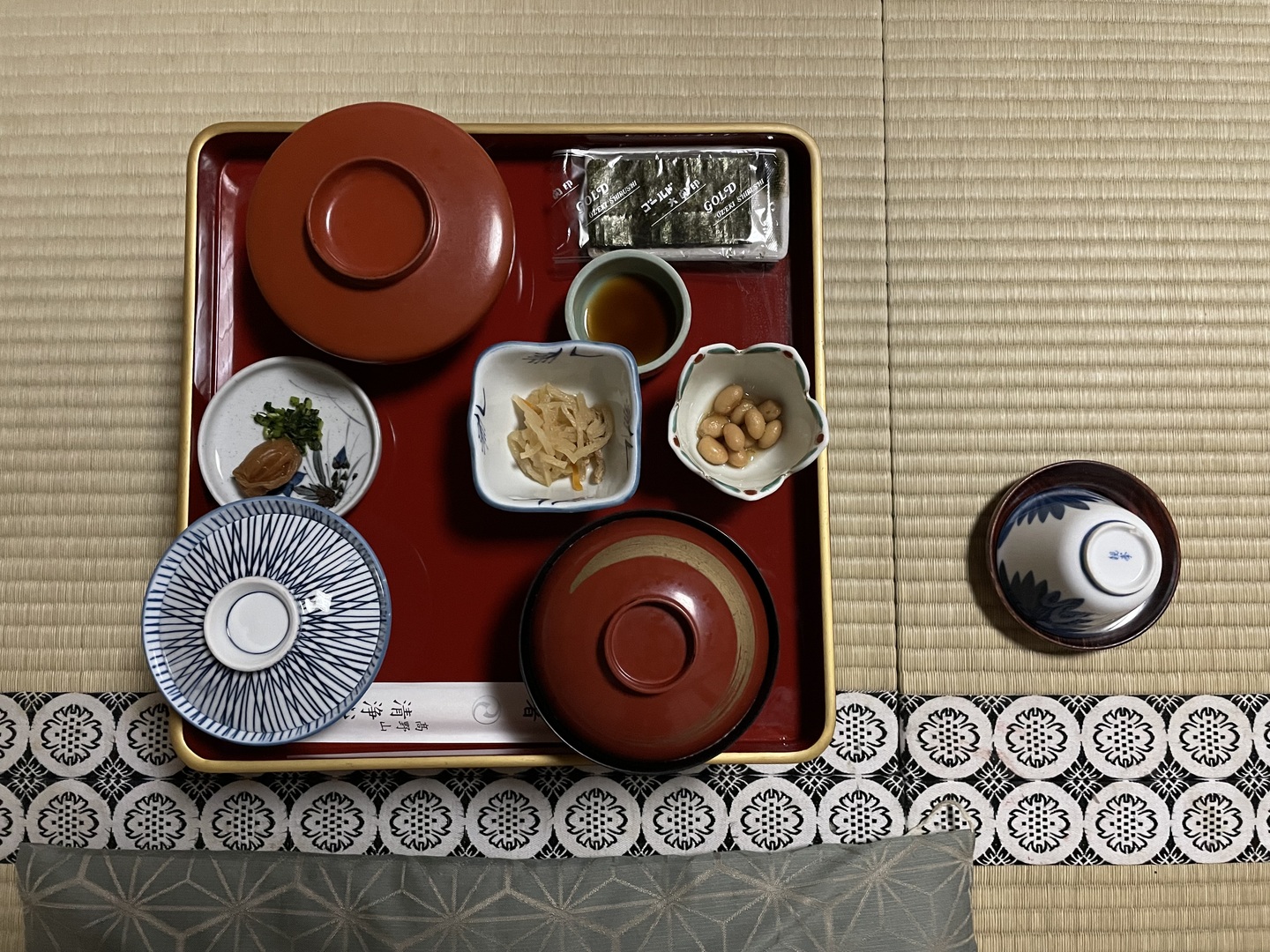
Kōya-san :: Shōjōshin-in :: shojin ryori
What have we done in Kōya-san?
- After arriving by a direct bus from Kyōto we stayed for a night in Shojoshin-in temple in the shukubō (pilgrim quarters) with the obligatory program of an onsen bath, vegan diner and breakfast according to the strict monk diet (shojin ryori), and witnessing morning gongyō ceremony (part of the Buddhist monks daily duties, o-tsutome) as well as a fire ceremony (goma-kito) later in the afternoon. Pictures.
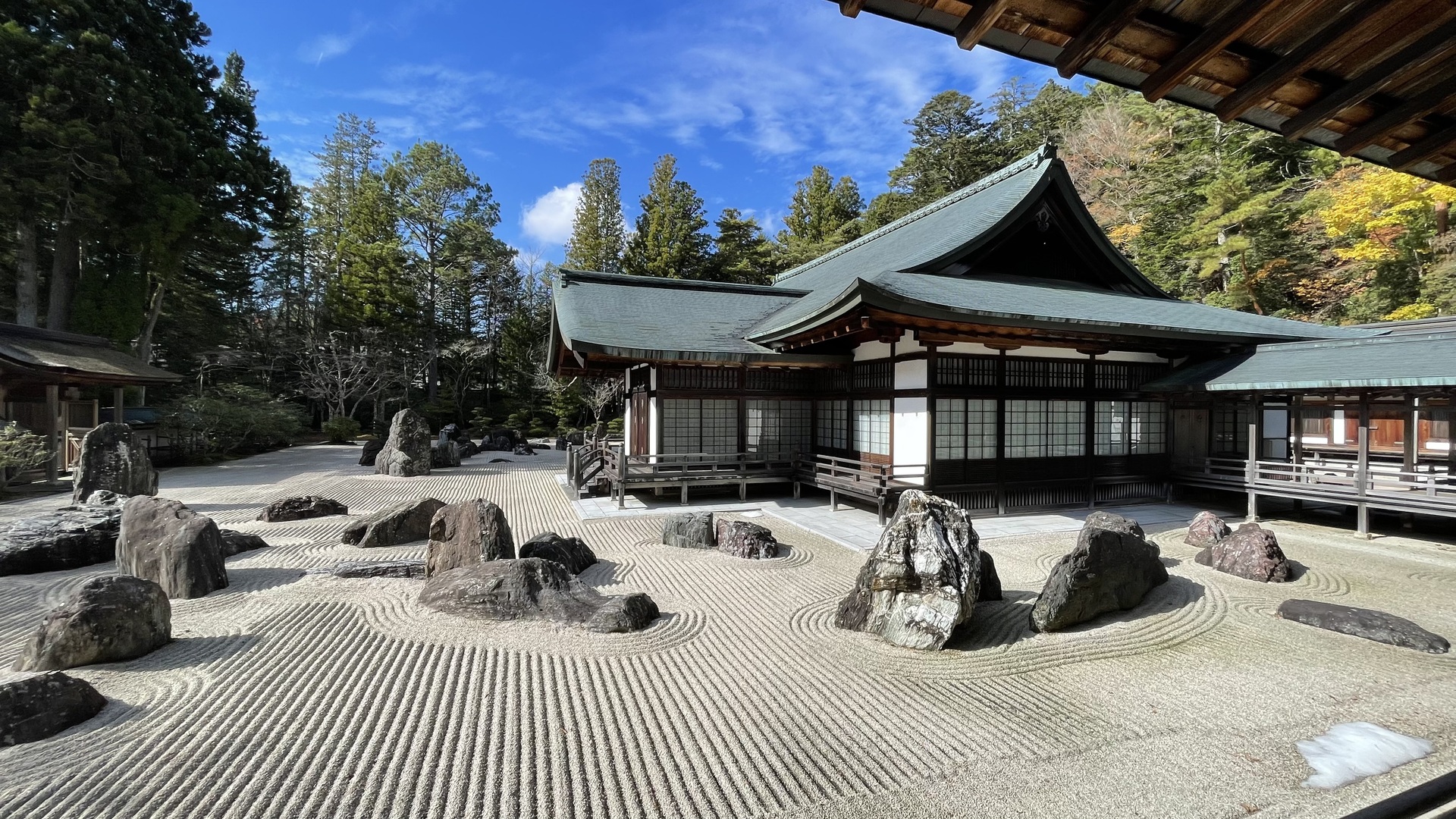
Kōya-san :: Kongōbu-ji :: Banryutei stone garden
- Next, the busy Kongōbu-ji, the truly head temple of the complex, and presently — together with the Tō-ji in Kyōto — the headquarters Shingon Buddhism temple (10 million believers claimed), with an impressive, quite recently built Banryutei stone garden. Noticeably, the temple was erected 1593 by the warlord Toyotomi Hideyoshi as Seigan-ji in the memory of his deceased mother O-Mandokoro who made pilgrimages to Kōya-san. The present temple is a merger of Seigan-ji and neighboring Kōzan-ji enforced by the Meiji era authorities in 1869. The stone garden is one of he largest in Japan and represents in its design a pair of dragons emerging from the sea of clouds in order to protect the okuden, the inner hidden teachings of the esoteric Buddhism. Granite from the island of Shikoku and the white sand from Kyōto. Numerous stylish rooms feature impressive sliding doors painted by Sengoku and Edo era masters. [For people interested in the Japanese history: in 1595, in Yanagi-no-ma, Willow Room (named after sliding door paintings), Toyotomi Hidetsugu committed seppuku after assisting suicides of his beloved three wakashū — an unimaginable act in a Buddhist temple, where it is forbidden to take life. The ritual suicides were thought to be ordered by his all-too-powerful nephew Toyotomi Hideyoshi himself due to alleged (or even fabricated) suspicions of Hidetsugu’s treachery. Please note that some historians disagree with this interpretation. Anyway, Hideyoshi went on in his cruel rage, erasing Hidetsugu’s whole family a few days later in the so-called Sanjogawara incident, a mass execution of everyone connected to Hidetsugi’s household — and even destroying Hidetsugu’s palace thoroughly. For the details, background and opinions, see the excellent article The Seppuku of Toyotomi Hidetsugu. Anyway, the whole matter is presently considered by scholars to be the pinnacle of samurai time nonsense cruelty.] Pictures.
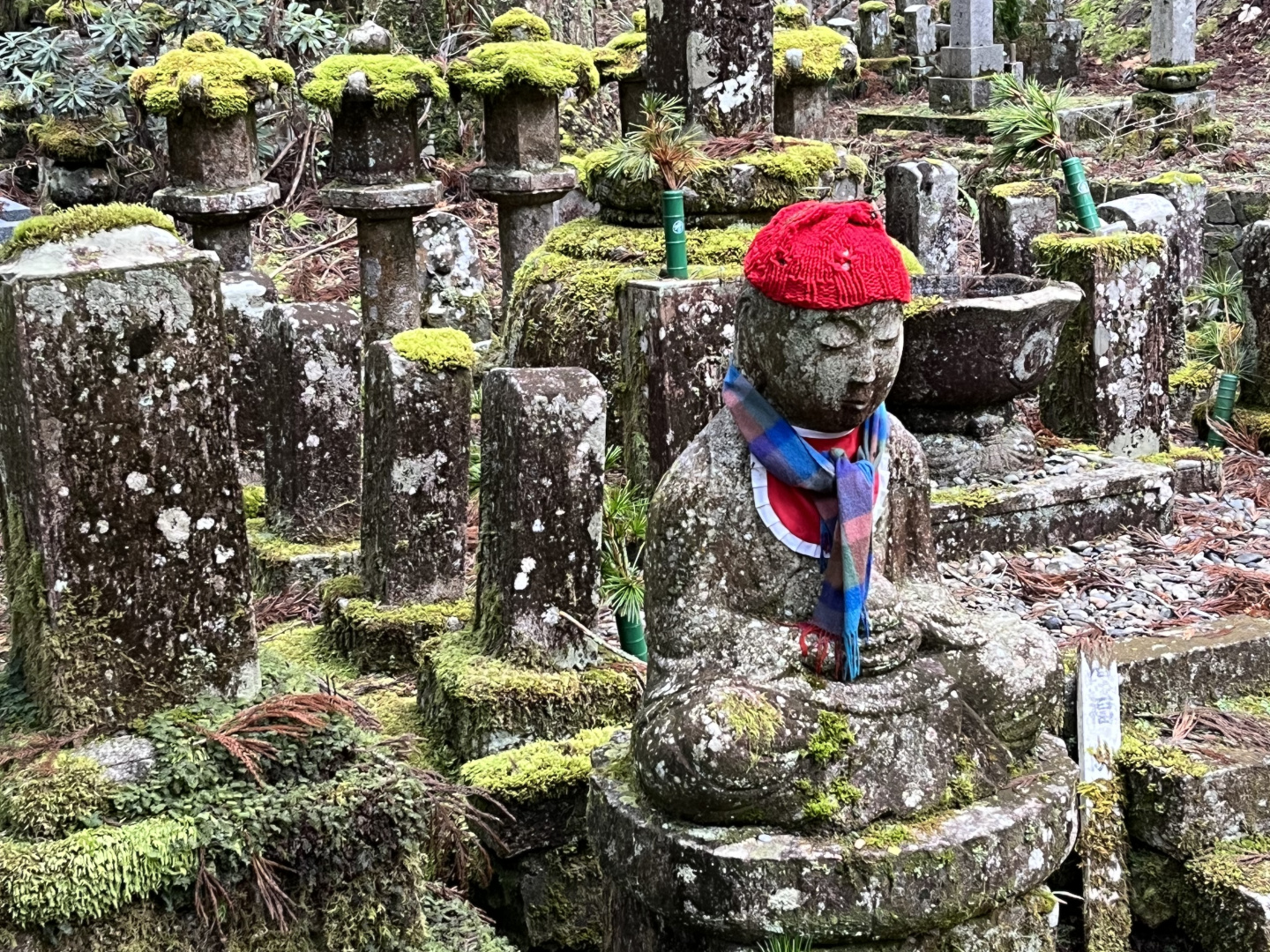
Kōya-san :: Oku-no-in :: a lonely Jizō
- Oku-no-in, a huge and ancient cemetery with numerous moss-covered tombs below tall conifer trees of more or less renowned personalities from the Japanese history, situated in a valley leading to the to the Kōbō Daishi Gobyō (mausoleum). About ten thousand lanterns provided by the pilgrims are permanently (hundreds of years!) lit in the mausoleum Tōrō-dō hall as well as in a building next to it built solely for this purpose. No food, no drinks, no pets, and no photography! Oku-no-in is said to be the largest cemetery of Japan, well over 200,000 graves, also with a modern section — presently, there is a trend of corporate tombs bought by large companies for their employees. The most memorable are numerous Jizō statues with woolen hats and sometime pullovers (it is cold here in the mountains!) and red baby bibs. Anyway, a very atmospheric and extraordinary place, we have visited it two times, in the evening and the next morning. See the list of monuments. Pictures
Kōya-san :: Nyonin-michi :: Benten-dake
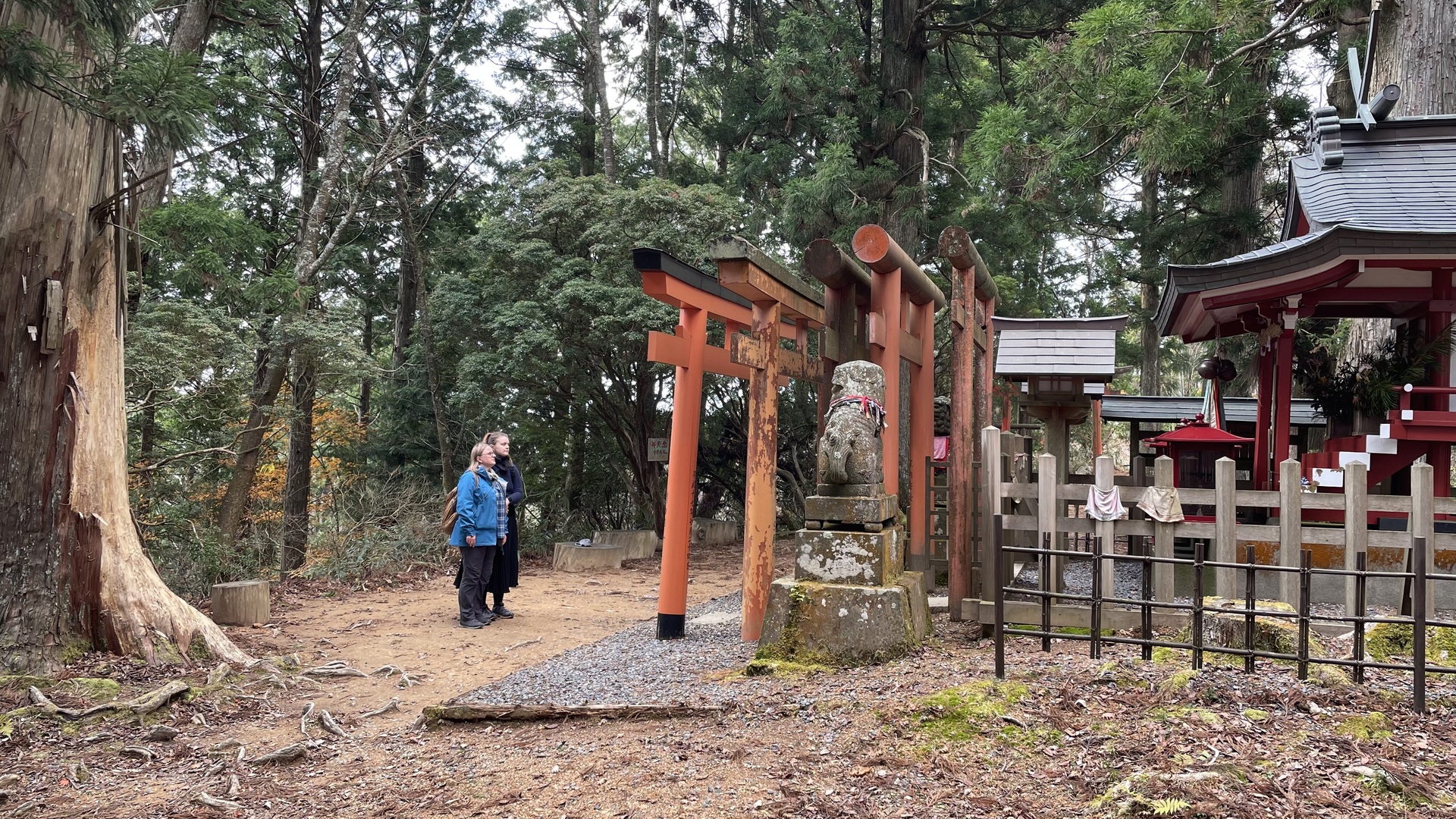
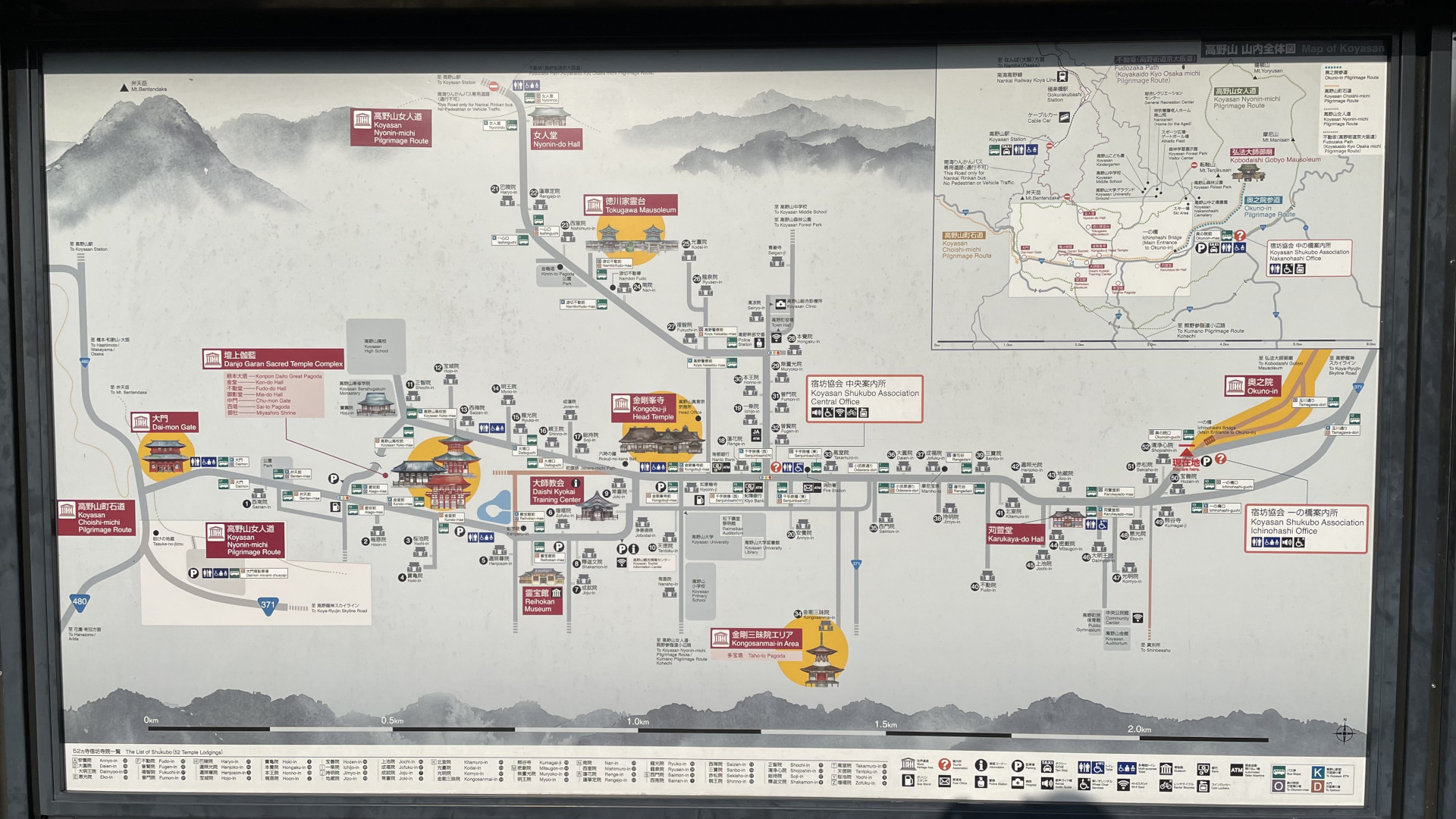
- Posh but elegant Tokugawa-ke Reidai, Tokugawa Family Mausoleum, where the spirits of two first shoguns of this dynasty, namely Ieyasu (1st) and Hidetada (2nd) are enshrined, the building erected by shogun Iemitsu (3rd). So far as we understand, these buildings do not contain any human remains and are purely symbolic.Walked a part of the women pilgrimage trail Nyonin-michi in the hills surrounding the monastic site — women could not have entered the site until 1872, so that in the past they had made a pilgrimage around the valley — with only one well-preserved Nyonin-dō hall (of seven) on the way where female pilgrims could stay and pray. We went from the pass forming the northwestern town entrance with the massive Otake-Jizō statue and a small Kosugi-myojin shrine just opposite Nyonin-dō all the way over Benten-dake mountain down to Dai-mon, the massive western entrance gate at the main road pass leading to the Kōya-san valley with two huge Kongō warriors statues on both sides — with the walk finished with a meal in the nearest and very decent inn, Tsukumo. It is about 3km along the main Kōya-san valley from Dai-Mon gate to the Kōbō Daishi Gobyō mausoleum at the end of Oku-no-in cemetery. Pictures.
- Finally, Koyasan Reihōkan Museum of Buddhist Art, with an exceptionally well sorted exhibition where one can learn to distinguish various Buddhist deities (at last…) and just opposite of the road Daishi Kyōkai Honbu, an administrative center of Shingon Buddhism, a traditional temple and a modern multi-purpose building with religion-connected activities. As we read in a brochure: There anyone can receive the ten Buddhist lay precepts (jukai, 受戒 ) that help one to lead a good and responsible life. The precepts ceremony takes about thirty minutes, and is given seven times every day to any interested person. So simple to become a Buddhist believer!
Kōya-san :: Kokuu GH :: tableware
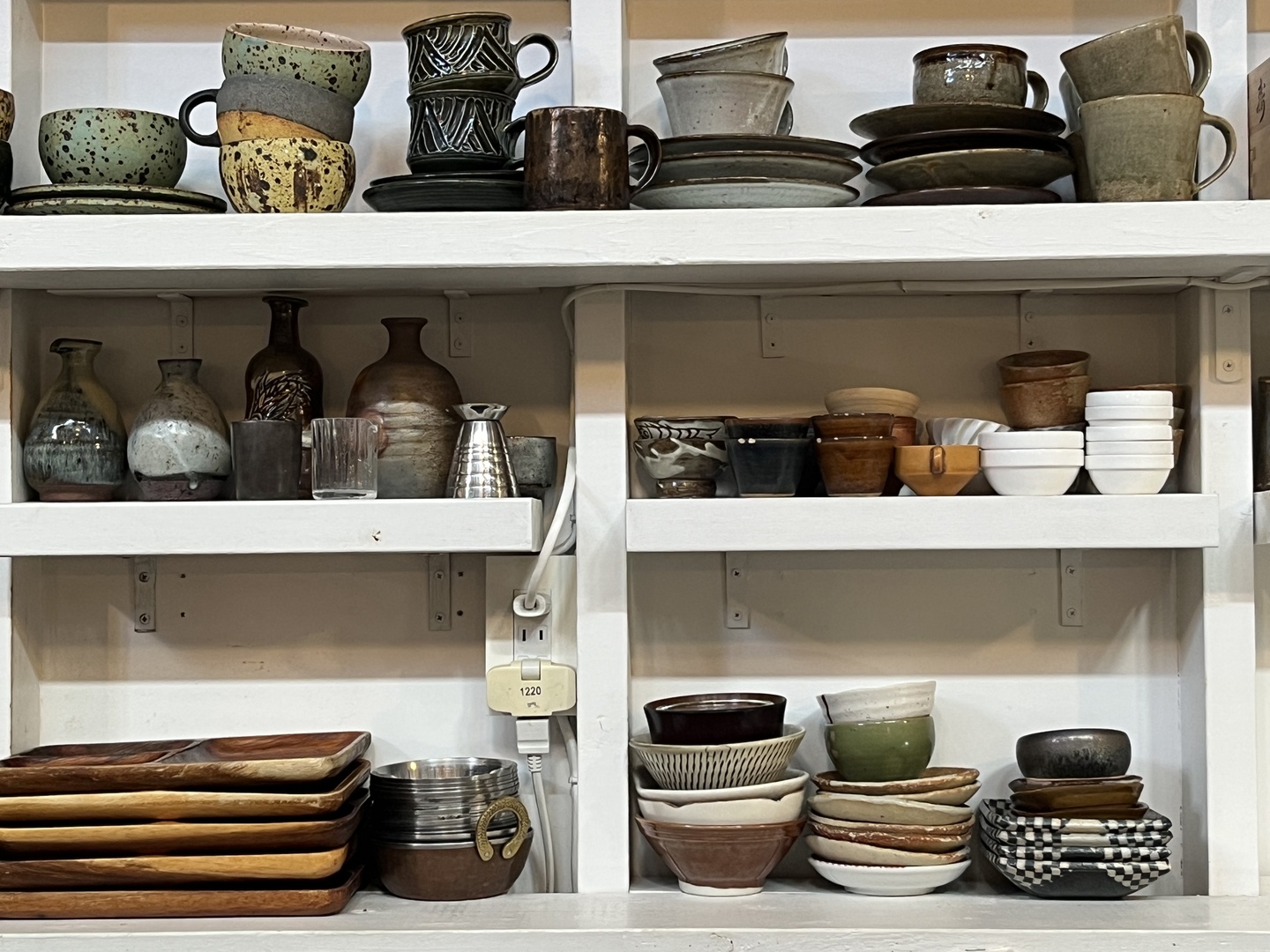
- Next two nights after the obligatory shukubō in Shojoshin-in we spent the nights in Kokuu capsule guest house with diners in the friendly Shunsai Kameya inn nearby, then taking bus, cable car and Limited Express train to Ōsaka Namba. Pictures.
Koyasan :: the town map